Field entry
Obsidian: A Volcanic Rock Made Almost Entirely of Glass
Strata & Seafloor Filed
The short answer
Obsidian is not a mineral under the NPS definition, which requires an ordered internal structure that generally forms crystals. Obsidian is volcanic glass: the USGS says it “forms in lava flows where the lava cools so fast that crystals do not have time to grow.” A 2020 USGS column calls it a volcanic rock, chemically classified as rhyolite.
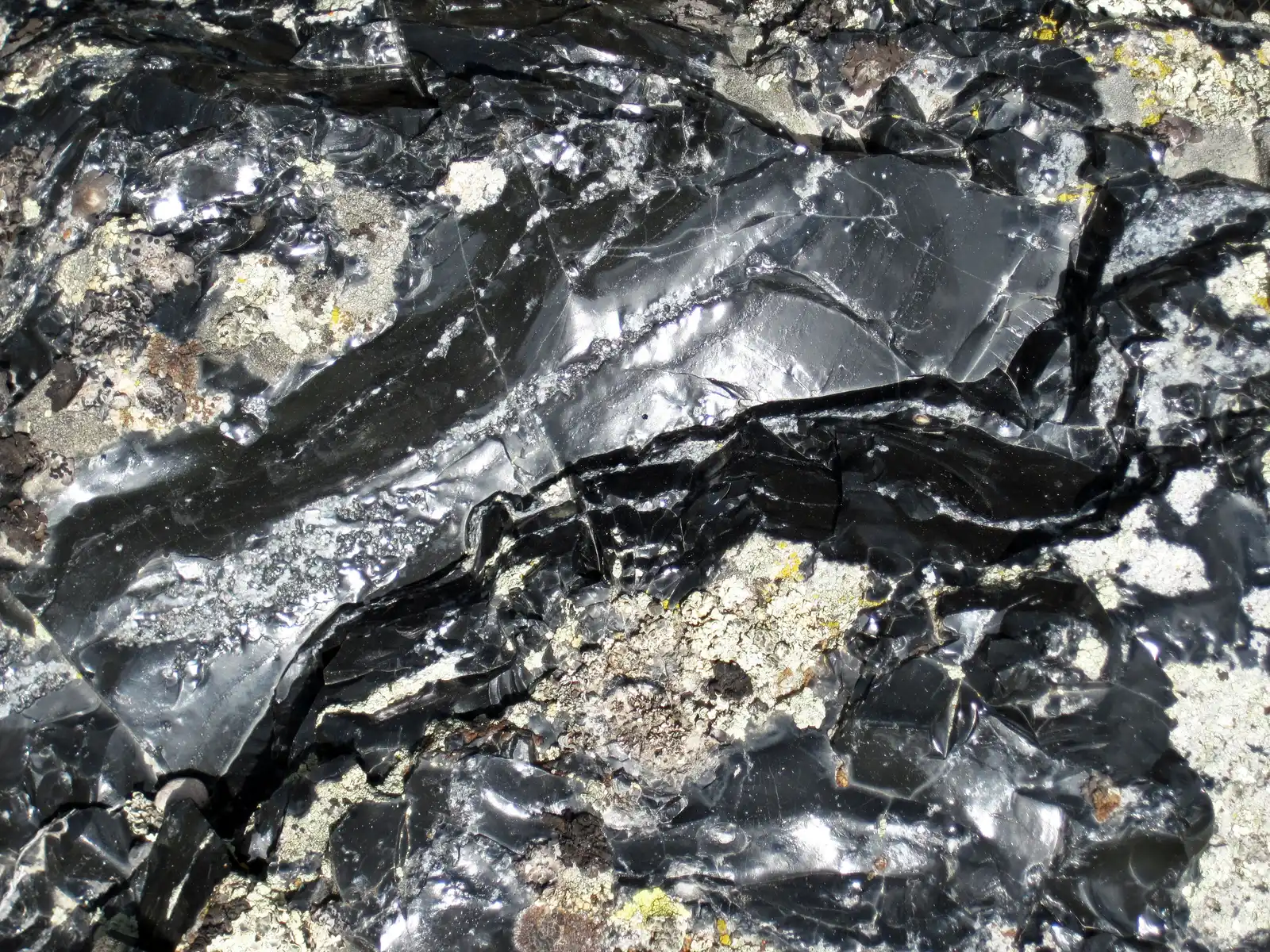
Black, glassy obsidian in a loose boulder near the base of Obsidian Cliff, with pale patches on its surface.
"Aphyric rhyolitic obsidian, Obsidian Cliff, Yellowstone" by James St. John — https://commons.wikimedia.org/wiki/File:Aphyric_rhyolitic_obsidian_(Roaring_Mountain_Member,_Plateau_Rhyolite,_Upper_Pleistocene,_~59_ka;_Obsidian_Cliff,_Yellowstone,_Wyoming,_USA)_4_(32933836788).jpg — CC BY 2.0 (https://creativecommons.org/licenses/by/2.0/)
At Obsidian Cliff in Yellowstone, a lava flow cooled into a wall of dark glass instead of crystals. The NPS gives the cliff an exposed vertical thickness of about 98 feet (30 m), unusual for a rock that mostly turns up as small pieces among other formations. A 2020 USGS column says the exposure stands 150 to 200 feet above the surrounding ground and runs about a half-mile, and the two figures measure different things. Rocks in national parks are protected; taking them is prohibited.
By the USGS figure, the Obsidian Cliff flow erupted around 106,000 years ago, just north of Yellowstone caldera. The photographer's description of the Commons photos on this page gives about 59,000 years instead, citing a 2010 master's thesis. This page lists both ages, and the Record card carries the USGS one.
Why isn't obsidian a mineral?
The NPS lists five characteristics required of all minerals. A mineral occurs naturally, is inorganic, is solid at room temperature (usually) and has a definite chemical composition. It must also have “a typical ordered internal structure,” in which “atoms have an orderly, repeated geometric pattern” that generally forms crystals.
Obsidian fails that structure test. The 2004 USGS Volcano Watch column explains that glass, “be it volcanic or manmade, cools quickly from a molten liquid without forming crystals, the building blocks of the minerals that make up most rocks.” By the NPS definition, then, obsidian is not a mineral, because its atoms never settled into a repeating pattern.
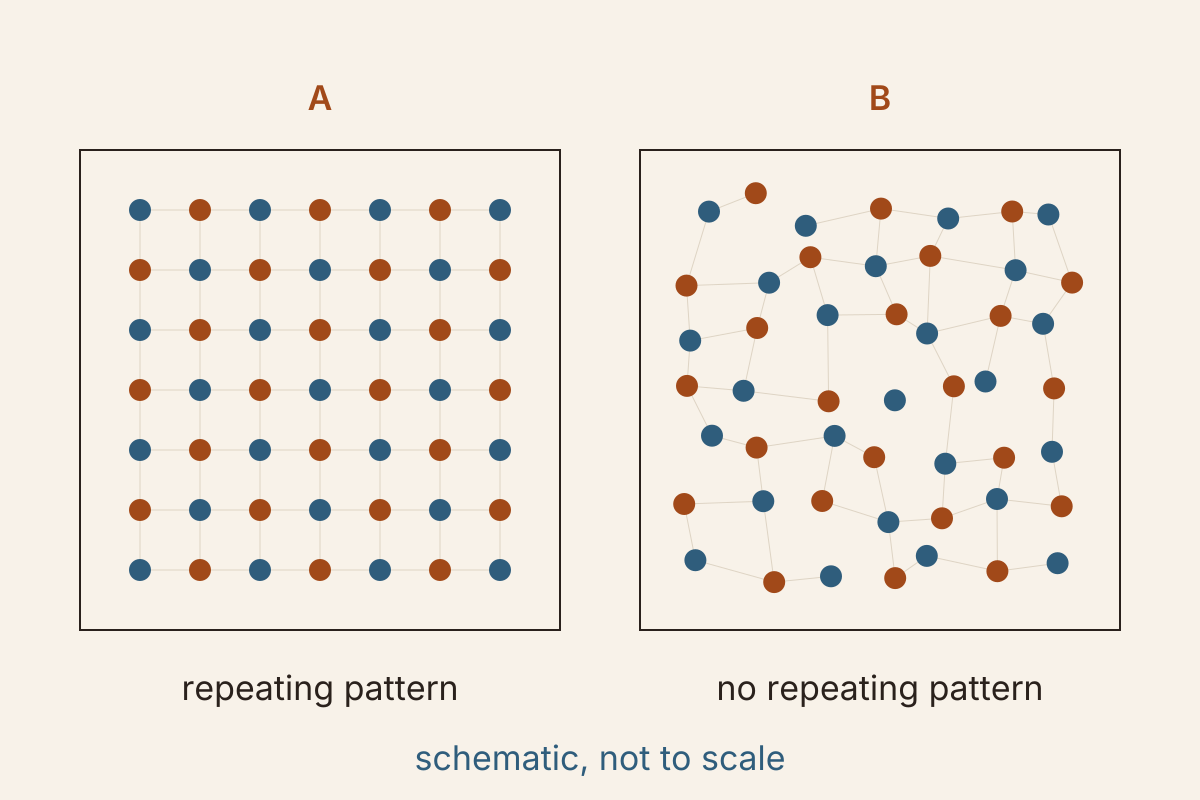
Atoms in a crystal and in glass, drawn as two panels of the same 49 dots; the drawing is schematic, not to scale.
Evidence The repeating-pattern rule from the NPS list of characteristics required of all minerals; glass without crystals from the USGS Volcano Watch column (2004); both panels hold 49 atoms.
Key to the letters and numbers
- A crystal: atoms in a repeating pattern, as in a mineral
- B glass: the same atoms with no repeating pattern, as in obsidian
"Atoms in a crystal and in glass, side by side" by Strata & Seafloor, https://strataandseafloor.com/rocks-minerals/obsidian/, licensed under CC BY 4.0 (https://creativecommons.org/licenses/by/4.0/)
Data: National Park Service, Minerals (U.S. Government work; No protection is claimed in original U.S. Government works), retrieved 2026-11-18; USGS Hawaiian Volcano Observatory, Volcano Watch, September 2, 2004 (U.S. Government work), retrieved 2026-11-18
The same column ties the break of the rock to that missing order. “Crystals impart a regular structure to materials,” it says, and without that structure glass “fractures in conchoidal, or smoothly curved, shapes.” The curved, shiny faces on the boulder at the top of this page are breaks of that kind.
Is obsidian a rock?
Yes. The 2020 USGS column calls it “the volcanic rock” and says it shares rhyolite chemistry with most Yellowstone eruptions while showing “a glassy texture and lack of crystals.” The photographer's description of the Commons photos calls it “a glassy-textured, extrusive igneous rock.” The 2004 column leaves room for that, since it describes minerals as making up most rocks, not all of them.
Mostly glass is not the same as entirely glass. The Volcano Watch column credits tiny crystals of iron oxide inside the glass for its dark color, and the photographer's description notes extremely small crystals that show up in thin sections. Those specks are minerals sitting in glass. The glass around them still has no crystal structure.
| Material | Crystal structure | How it formed |
|---|---|---|
| obsidian | glass; tiny crystals can be present | silica-rich, viscous lava that cools so fast that crystals do not have time to grow |
| any mineral | yes | formed naturally by geological processes, with an ordered internal structure |
| crystal-bearing Yellowstone rhyolite | 5% to 15% crystals by volume | rhyolite lava from a large, crystal-rich magma reservoir |
| Obsidian Cliff flow rhyolite | almost none | small, very hot batch of rhyolite magma that erupted as a lava flow |
| black glassy andesite | no | cooled in just seconds, so mineral grains had no time to grow |
| partly devitrified obsidian | partly | glass in which silica slowly rearranges into crystal structures over very long times |
| granite | yes | magma that cools slowly underground, so minerals grow into large crystals |
Download the obsidian and minerals table (CSV) (sources and license of this file) Data: National Park Service, Minerals and Obsidian Cliff (U.S. Government works; No protection is claimed in original U.S. Government works), retrieved 2026-11-18; USGS Volcano Hazards Program glossary; USGS Yellowstone Volcano Observatory (2020); USGS Volcano Watch (2004); USGS GIP 19; USGS What's New? Weeks 9-12 (U.S. Government works), retrieved 2026-11-18; James St. John, Commons file description (CC BY 2.0), retrieved 2026-11-18
The Record card lists two lookalikes. A USGS classroom activity pairs obsidian with black glassy andesite, a rock that “cooled in just seconds,” so its mineral grains “had no time to grow.” The 2004 column adds that most geologists and archeologists distinguish the thin, glassy rind on an otherwise crystalline lava flow from glass that erupts as thick flows or domes; its authors call the rind “volcanic glass” and keep the name obsidian for the thick flows. Rinds of that kind come up again in pillow lava.
How fast does lava have to cool?
The USGS Volcano Hazards Program glossary puts it in one line: “Obsidian forms in lava flows where the lava cools so fast that crystals do not have time to grow.” Speed is only half of the answer. The 2020 USGS column says the magma is rhyolite, typically more than 74% SiO2 by weight, and that “the rapid cooling and high viscosity of the magma prevents crystals from forming.” The Volcano Watch column adds a very low water content to the list.
Obsidian Cliff adds one more condition. The 2020 USGS column says the Obsidian Cliff flow holds close to 0% crystals, while most rhyolite flows erupted within Yellowstone caldera hold 5% to 15% crystals by volume. Its explanation is heat: basalt magma rising along faults between Norris and Mammoth melted the crust into a small, very hot batch of rhyolite, hot enough that crystals had not formed before it erupted.
Cooling speed sets grain size in other igneous rocks as well. A USGS classroom guide describes a black glassy andesite that cooled “in just seconds” and says the massive interior of a lava flow “requires days to years for complete cooling.” A USGS education page adds that lava cooling quickly at the surface grows small, hard-to-see minerals, while magma cooling slowly underground grows crystals large enough to pick out in a granite countertop.
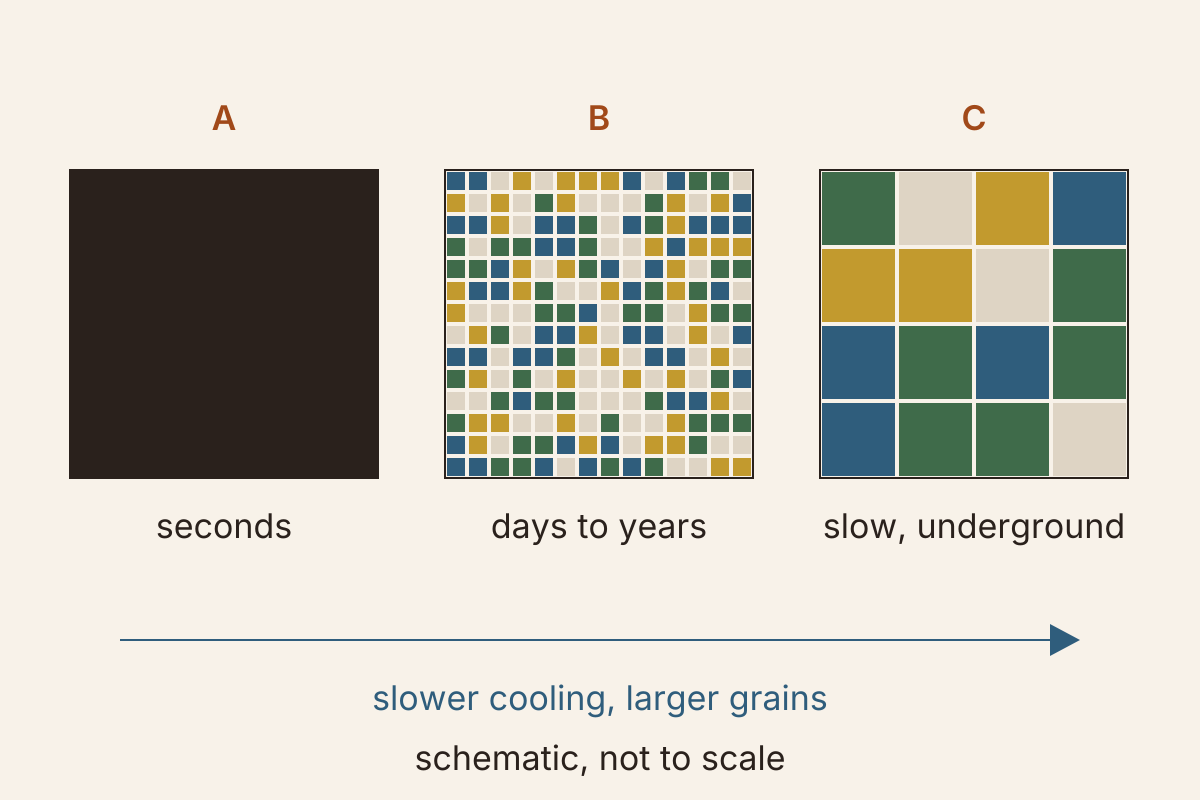
Cooling speed against grain size in igneous rock: generally, the faster the cooling, the smaller the grains, down to none at all; the drawing is schematic, not to scale.
Evidence Cooling times and textures from the USGS Rock Stars activity (GIP 19) and the USGS What's New? Weeks 9–12 page; grain sizes are drawn relative to each other, not measured.
Key to the letters and numbers
- A rock that cooled in seconds, such as black glassy andesite: glassy, no grains
- B interior of a lava flow, days to years to cool: fine grains
- C magma cooling slowly underground, as in granite: coarse grains
"Cooling speed against grain size in igneous rock" by Strata & Seafloor, https://strataandseafloor.com/rocks-minerals/obsidian/, licensed under CC BY 4.0 (https://creativecommons.org/licenses/by/4.0/)
Data: USGS General Information Product 19, Rock Stars (U.S. Government work), retrieved 2026-11-18; USGS Educational Resources, What's New? Weeks 9-12 (U.S. Government work), retrieved 2026-11-18
Why is obsidian black? The Volcano Watch column credits “tiny crystals of iron oxide” for the dark color and says different oxidation states of iron “can tint the obsidian red, brown, or green.” The USGS classroom guide gives a shorter answer for its black glassy rock: “Black color is caused by light absorption.” Where glassy rock sits among the three rock types is laid out in the rock cycle.
Is obsidian always glass?
Glass does not last on geologic time scales. The Volcano Watch column says most obsidian is younger than 20 million years, because older obsidian “has devitrified, or changed from glass to crystalline rock,” as its silica slowly rearranges into organized crystal structures. The Obsidian Cliff flow's age, about 106,000 years by the USGS figure, is about 0.53% of that 20-million-year span.
Given enough time, then, obsidian moves toward the ordered structure that the NPS mineral definition asks for. The photographer's description of the cliff photo below says the rocks at Obsidian Cliff are weathered, partially devitrified and lichen-covered. It identifies many of the whitish spots in the cliff's rock as areas of devitrification made of cristobalite, a form of silica, rather than glass.
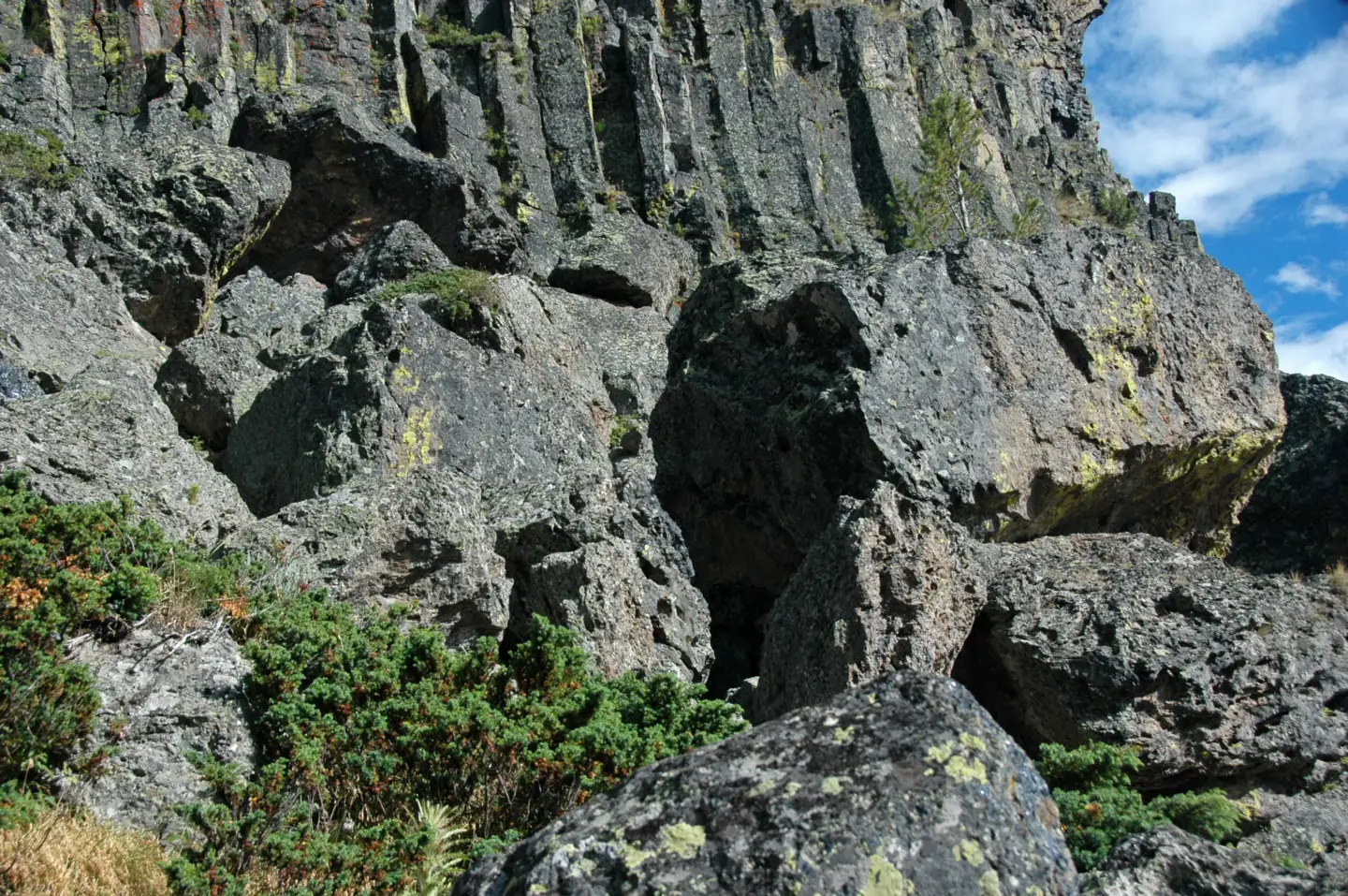
Part of the Obsidian Cliff face, its dark rock weathered, partially devitrified and spotted with lichen, by the photographer's description.
"Rhyolitic obsidian lava flow, Obsidian Cliff, Yellowstone" by James St. John — https://commons.wikimedia.org/wiki/File:Columnar-jointed_rhyolitic_obsidian_lava_flow_(Roaring_Mountain_Member,_Plateau_Rhyolite,_Upper_Pleistocene,_~59_ka;_Obsidian_Cliff,_Yellowstone,_Wyoming,_USA)_33_(46766598282).jpg — CC BY 2.0 (https://creativecommons.org/licenses/by/2.0/); modified: resized
Where you can see obsidian
Obsidian Cliff sits on the Grand Loop Road between Mammoth and Norris in Yellowstone National Park, and the NPS lists it as a National Historic Landmark, designated in 1996. The park's page says the roadside kiosk there, built in 1931, was the first wayside exhibit in a US national park. The NPS also records that people quarried obsidian from the cliff more than 11,000 years ago. Rocks in Yellowstone National Park are protected; taking rocks is prohibited.
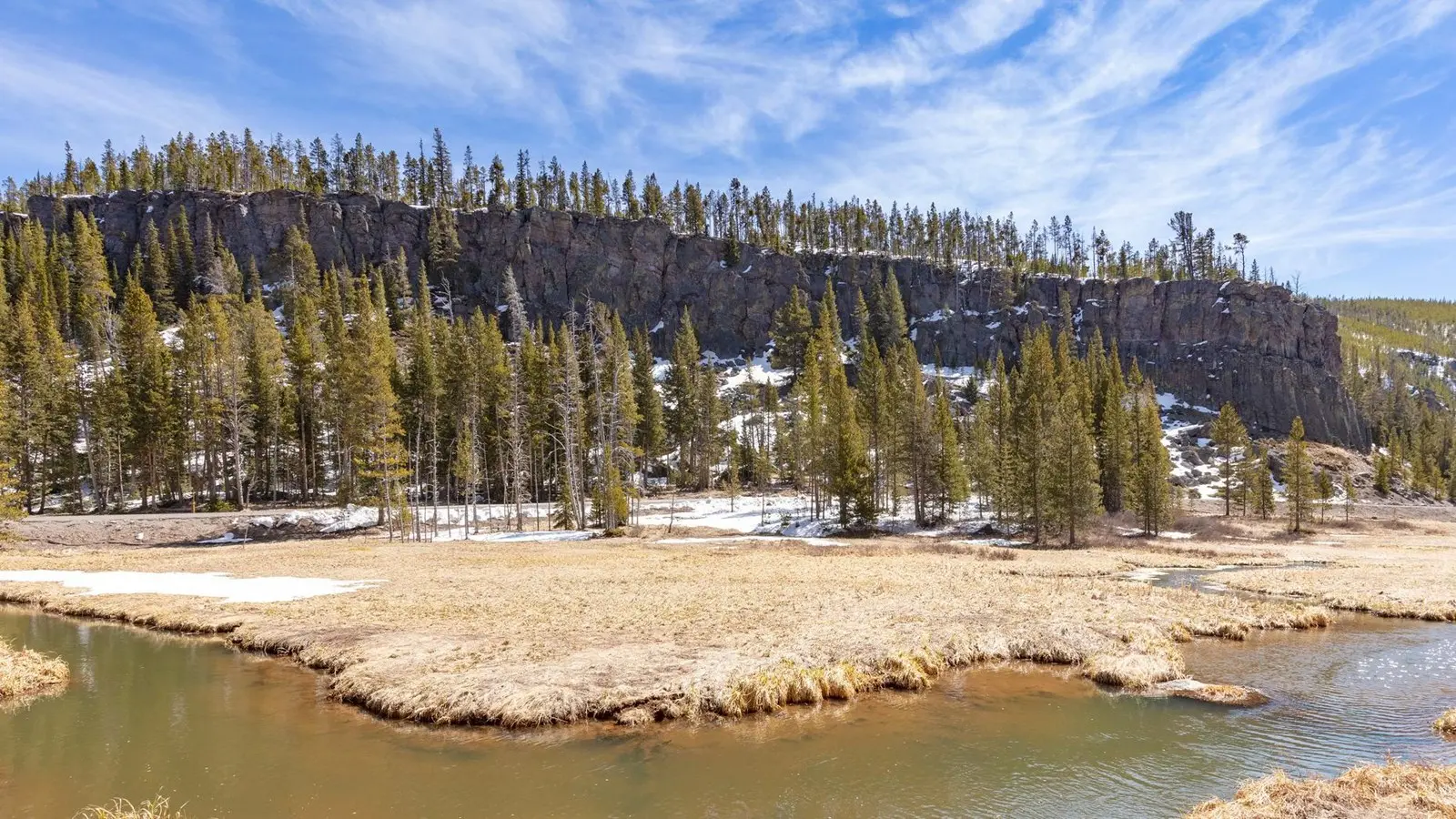
Obsidian Cliff, the dark band of rock above the trees, seen across a meadow and a creek along the Grand Loop Road.
"Obsidian Cliff, Yellowstone National Park" by NPS / Jacob W. Frank — https://www.nps.gov/places/000/obsidian-cliff.htm — Public Domain (US: U.S. Government work (17 U.S.C. §105), credited NPS / Jacob W. Frank on the NPS page; EU: no statutory public-domain basis, agency public-domain marking. No protection is claimed in original U.S. Government works)
The 2004 USGS column names two more places with obsidian flows: the Big Obsidian Flow in Newberry Crater, Oregon, and Glass Mountain in northern California. This page does not appraise, authenticate or price specimens, and it names places to look, not places to collect.
On hardness, the NPS chart for the Mohs hardness scale places a glass plate at 5.5. Grain size, the feature obsidian lacks, is the first clue in rock identification, and a volcano whose summit collapsed during an eruption is the subject of Crater Lake.
Sources
- National Park Service, "Minerals" (Geology). www.nps.gov/subjects/geology/minerals.htmRead: full textText license: U.S. Government work. No protection is claimed in original U.S. Government works (terms)
- U.S. Geological Survey, Volcano Hazards Program, "Volcano Hazards Program Glossary". www.usgs.gov/glossary/volcano-hazards-program-…Read: full text (Pillow lava and Obsidian entries used)Text license: U.S. Government work (17 U.S.C. §105) (terms)
- Mark Stelten, "Yellowstone's tool-making lava flows", Yellowstone Caldera Chronicles, U.S. Geological Survey Yellowstone Volcano Observatory, October 19, 2020. www.usgs.gov/observatories/yvo/news/yellowston…Read: full textText license: U.S. Government work (17 U.S.C. §105) (terms)
- U.S. Geological Survey Hawaiian Volcano Observatory, "Volcano Watch — Obsidian, a scarce commodity in Hawaiʻi", September 2, 2004. www.usgs.gov/news/volcano-watch-obsidian-a-sca…Read: full textText license: U.S. Government work (17 U.S.C. §105) (terms)
- National Park Service, "Obsidian Cliff" (place page, Yellowstone National Park; last updated January 1, 2025). www.nps.gov/places/000/obsidian-cliff.htmRead: full textText license: U.S. Government work. No protection is claimed in original U.S. Government works (terms)
- National Park Service, Yellowstone National Park, "Obsidian Cliff" (History & Culture; last updated April 18, 2025). www.nps.gov/yell/learn/historyculture/obsidia…Read: full textText license: U.S. Government work. No protection is claimed in original U.S. Government works (terms)
- U.S. Geological Survey, "Rock Stars", in Living with a Volcano in Your Backyard: An Educator's Guide with Emphasis on Mount Rainier, General Information Product 19 (prepared in collaboration with the National Park Service; activity last modified November 21, 2014). pubs.usgs.gov/gip/19/downloads/Chapter_2/Activi…Read: full textText license: U.S. Government work (17 U.S.C. §105) (terms)
- U.S. Geological Survey Educational Resources, "What's New? Weeks 9-12" (Week 12: Rocks and Minerals). www.usgs.gov/educational-resources/whats-new-w…Read: full textText license: U.S. Government work (17 U.S.C. §105) (terms)
- James St. John, "Aphyric rhyolitic obsidian (Roaring Mountain Member, Plateau Rhyolite, Upper Pleistocene, ~59 ka; Obsidian Cliff, Yellowstone, Wyoming, USA) 4", file description on Wikimedia Commons, 2011, CC BY 2.0. commons.wikimedia.org/wiki/File:Aphyric_rhyolitic_obsid…Read: file page (description and license)Text license: CC BY 2.0 (terms)
- James St. John, "Columnar-jointed rhyolitic obsidian lava flow (Roaring Mountain Member, Plateau Rhyolite, Upper Pleistocene, ~59 ka; Obsidian Cliff, Yellowstone, Wyoming, USA) 33", file description on Wikimedia Commons, 2011, CC BY 2.0. commons.wikimedia.org/wiki/File:Columnar-jointed_rhyoli…Read: file page (description and license)Text license: CC BY 2.0 (terms)
- National Park Service, "Mohs Hardness Scale" (article, last updated April 12, 2023). www.nps.gov/articles/mohs-hardness-scale.htmRead: full textText license: U.S. Government work. No protection is claimed in original U.S. Government works (terms)
- Ed Klimasauskas, Charles Bacon and Jim Alexander, "Mount Mazama and Crater Lake: Growth and Destruction of a Cascade Volcano", U.S. Geological Survey Fact Sheet 092-02 (2002). pubs.usgs.gov/fs/2002/fs092-02/Read: full text of the web versionText license: U.S. Government work (17 U.S.C. §105) (terms)


Cite this page
Strata & Seafloor. “Obsidian: A Volcanic Rock Made Almost Entirely of Glass.” First published November 18, 2026. https://strataandseafloor.com/rocks-minerals/obsidian/. Accessed on the day you read it.
How ages and sources are checkedAll correctionsReport an error on this page (contact@strataandseafloor.com)
Also in Rocks & Minerals
RM Interactive or diagram page
Rock Identification: Look at Grain Size Before Color
Filed
Picture credit
"Granite or granodiorite (Sierra Nevada Batholith, Early Cretaceous)" by James St. John — https://commons.wikimedia.org/wiki/File:Granite_or_granodiorite_(Sierra_Nevada_Batholith,_Early_Cretaceous;_Lower_Rock_Creek_Road,_near_Bishop,_California,_USA)_(30715327533).jpg — CC BY 2.0 (https://creativecommons.org/licenses/by/2.0/)
RM Comparison and scale list
Rock Cycle: Any Rock Type Can Become Any Other
Filed
Picture credit
"Black Hand Sandstone (Lower Mississippian; Rock House, Hocking Hills, Ohio, USA) 2" by James St. John — https://commons.wikimedia.org/wiki/File:Black_Hand_Sandstone_(Lower_Mississippian;_Rock_House,_Hocking_Hills,_Ohio,_USA)_2.jpg — CC BY 2.0 (https://creativecommons.org/licenses/by/2.0/)
RM Comparison and scale list
Mohs Hardness Scale: The Steps Are Ranks, Not Equal Units
Filed
Picture credit
"Portrait of Friedrich Mohs, lithograph, 1832" by Kriehuber (artist); Gebr. Mansfeld & Comp. (printer) — https://commons.wikimedia.org/wiki/File:Friedrich_Mohs_portrait_by_Kriehuber_1832.jpg — Public Domain (US: published 1832, before January 1, 1931; EU: artist Kriehuber d. 1876 (Commons marks the file PD-old-100 and Public Domain Mark 1.0); faithful reproduction of a two-dimensional work)