Field entry
Pillow Lava: A Glassy Rind Forms Where Lava Meets Water
Strata & Seafloor Filed
The short answer
Pillow lava is lava, usually basalt, that erupted under water or flowed into it and cooled as stacked, rounded lobes. A USGS publication on Hawaiian volcanoes says each lobe is sack- or pillow-shaped in cross section. Each has a glassy outer skin from rapid cooling by water, and they typically range from less than a foot to several feet across.
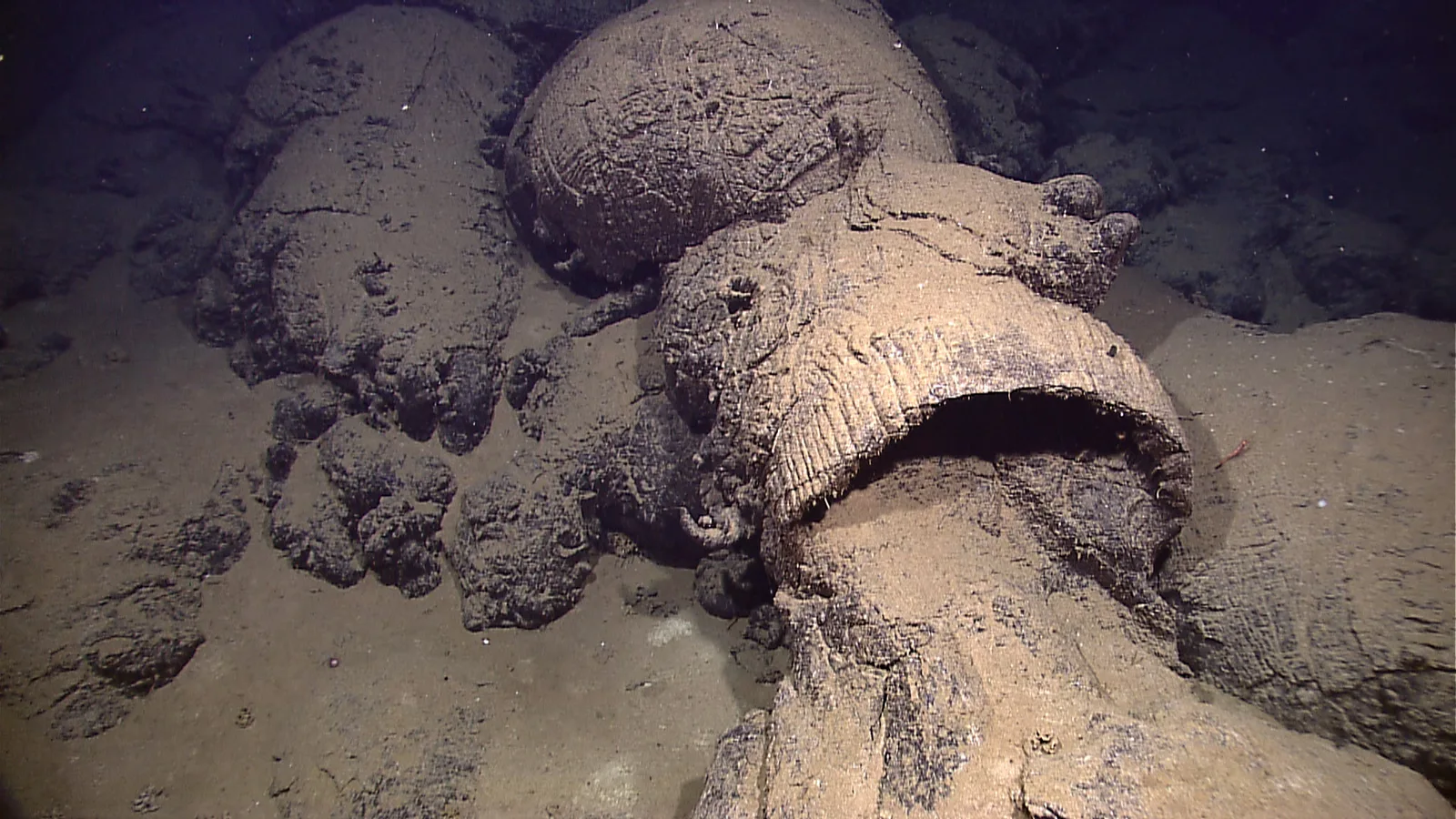
A collapsed pillow of lava on the Galápagos Rift seafloor, photographed in 2011, with lava frozen in place after flowing out.
“Expl6426 - broken pillow lava, NOAA Okeanos Explorer Program, Galapagos Rift Expedition 2011”, NOAA Okeanos Explorer Program, Galapagos Rift Expedition 2011; public domain.
Full credit
"Expl6426 - broken pillow lava, NOAA Okeanos Explorer Program, Galapagos Rift Expedition 2011" by NOAA Okeanos Explorer Program, Galapagos Rift Expedition 2011 — https://commons.wikimedia.org/wiki/File:Expl6426_-_broken_pillow_lava.jpg — Public Domain (US: U.S. Government work (17 U.S.C. §105), NOAA Okeanos Explorer Program photo taken as part of an employee's official duties per the file page (PD-USGov-NOAA); EU: no statutory public-domain basis, agency public-domain marking; upstream not traced)
On a broken pillow of lava photographed on the Galápagos Rift, the outer shell stands open like a split sack. NOAA's Okeanos Explorer program recorded the scene on 21 July 2011. The photo's description calls it a collapsed pillow, “with the lava frozen in place after flowing out.” Read like a case file, the rounded shell is the entry that shows where this lava cooled: in water.
How does a pillow form?
Pillow lava begins with lava that keeps moving after it meets water. According to the USGS publication on Hawaiian volcanoes, it forms “when molten lava breaks through the thin walls of underwater tubes, squeezes out like toothpaste, and quickly solidifies as irregular, tongue-like protrusions.” The process repeats “countless times,” and the protrusions stack one upon another as the flow advances.
Scale schematic, not to scale
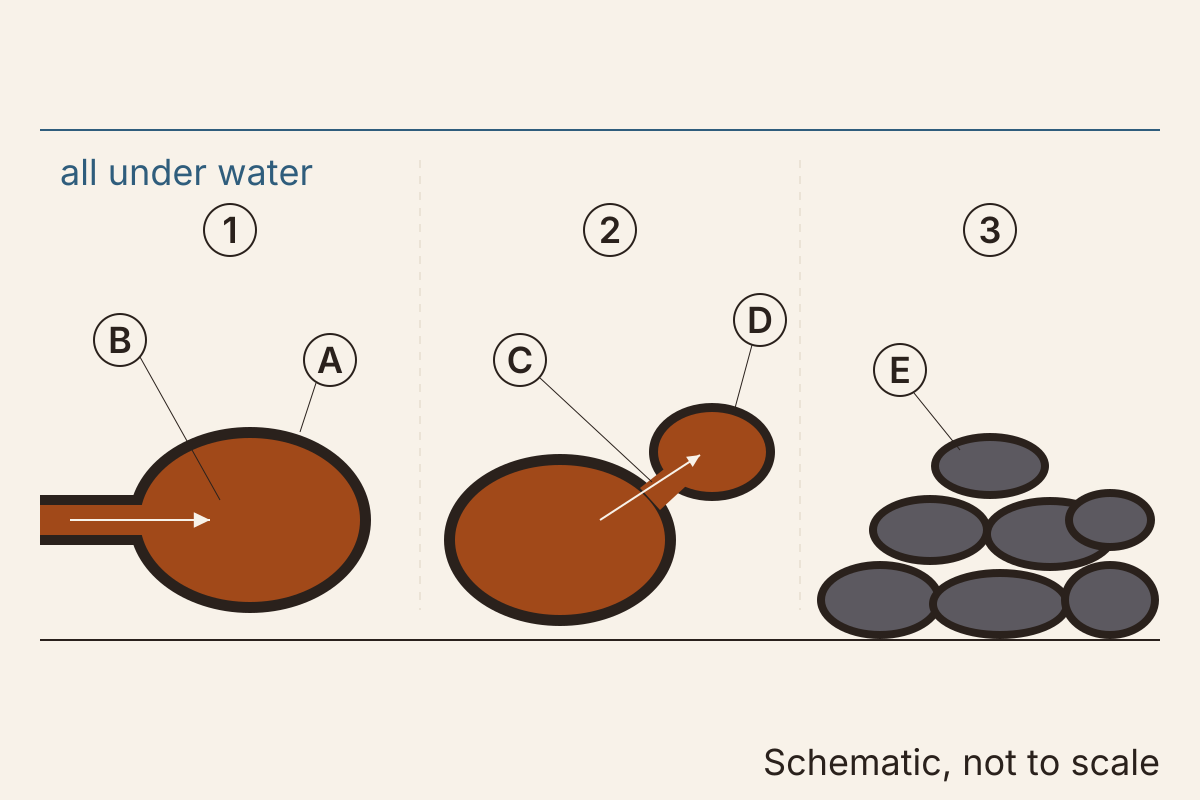
Three stages under water: a lobe chills on the outside, its skin breaks and feeds a new lobe, and the lobes pile up as pillows.
Evidence Drawn from the formation steps in the USGS publication Eruptions of Hawaiian Volcanoes and a 2026 USGS California Volcano Observatory article; shapes are relative, not measured.
Key to the letters and numbers
- 1 a lobe pushes out of a lava tube
- 2 the skin cracks and a new lobe squeezes out
- 3 cooled lobes stacked, seen in cross section
- A glassy outer skin, chilled by the water
- B molten interior, kept hot inside the skin
- C break in the skin
- D new lobe
- E pillows, sack- or pillow-shaped in cross section
"How pillow lava forms" by Strata & Seafloor, https://strataandseafloor.com/seafloor/pillow-lava/, licensed under CC BY 4.0 (https://creativecommons.org/licenses/by/4.0/)
Data: USGS, Eruptions of Hawaiian Volcanoes: Past, Present, and Future, General Interest Publication, page 38 (U.S. Government work), retrieved 2026-11-18; USGS California Volcano Observatory, A. Pivarunas, Don't try to have a pillow fight with these pillows! (29 July 2026; U.S. Government work), retrieved 2026-11-18
The glassy skin explains the shape. Anthony Pivarunas, a USGS geophysicist, wrote in 2026 that the outside of a lobe “cools rapidly, which forms a glassy skin.” That chilled skin “is a great insulator,” he adds, so the hot lava inside can keep swelling the pillow. In the USGS Volcano Hazards Program glossary, the result is “mounds of elongate lava pillows formed by repeated oozing and quenching of hot basalt.”
Meeting water does not usually make this lava explode. Much pillow lava comes out under relatively high pressure from the weight of the water above it, the Hawaiian volcano publication says, and “there is little or no explosive interaction between hot lava and cold water.”
Where pillows form on the seafloor
Geologists usually link pillow lava with the ocean floor. Pivarunas gives the reason: “the majority of new crust formed at mid-ocean ridges is made up of pillowed basalt lava flows.” The USGS book This Dynamic Earth says magma rises at a ridge and “eventually erupts along the crest of the ridges to create new oceanic crust.” The same book calls basalt “the iron-rich, volcanic rock making up the ocean floor.”
Scale schematic, not to scale
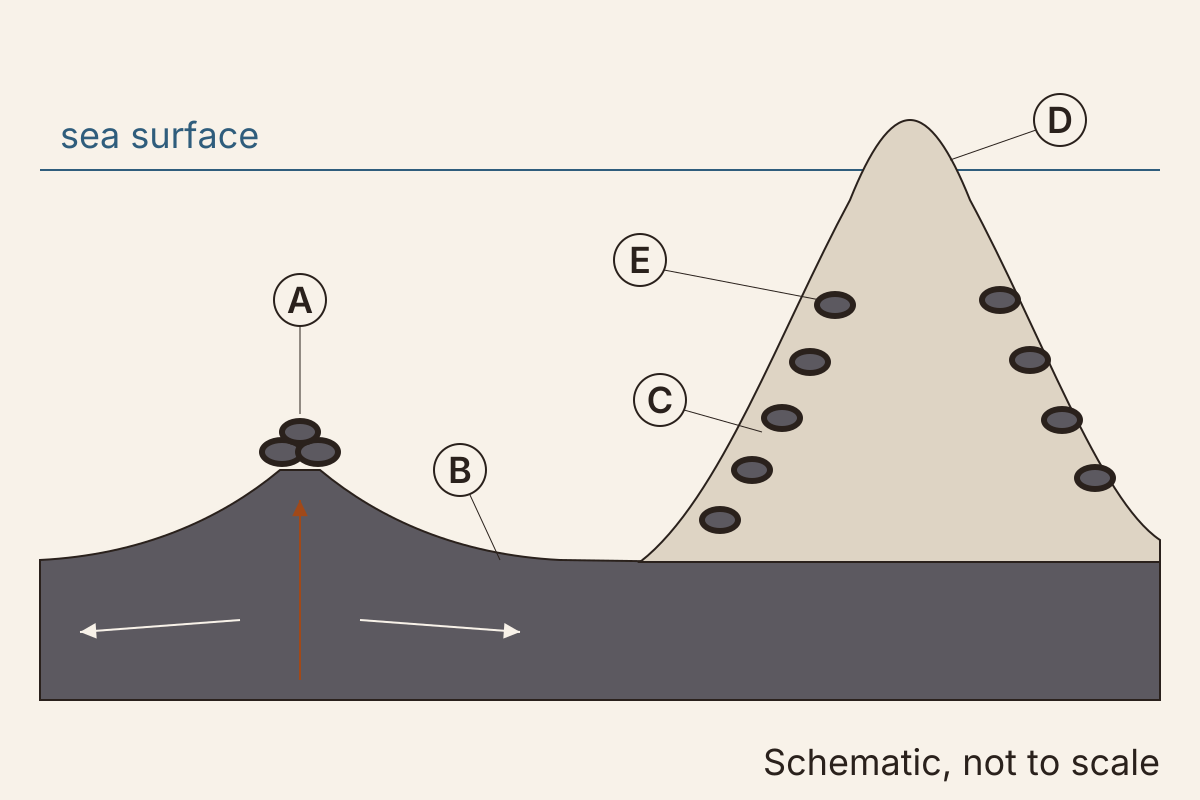
Pillows form where lava erupts under the sea: on the crest of a mid-ocean ridge and on the underwater flanks of an ocean island volcano.
Evidence Drawn from USGS This Dynamic Earth (ridge crest), the 2026 USGS California Volcano Observatory article (pillowed crust at ridges) and Eruptions of Hawaiian Volcanoes (Mauna Loa); 2,500 feet converted at 0.3048 m per foot.
Key to the letters and numbers
- A pillows on a ridge crest, where magma erupts to make new oceanic crust
- B new ocean crust moving away from the crest, mostly pillowed basalt flows
- C underwater flank of an ocean island volcano; in a Hawaiian volcano, the bulk of this part is pillow lava
- D the part of the volcano above sea level
- E pillow lava on the submerged west slope of Mauna Loa, at about 2,500 feet (about 760 m) of water
"Where pillow lava forms on the seafloor" by Strata & Seafloor, https://strataandseafloor.com/seafloor/pillow-lava/, licensed under CC BY 4.0 (https://creativecommons.org/licenses/by/4.0/)
Data: USGS, This Dynamic Earth, Developing the theory (U.S. Government work), retrieved 2026-11-17; USGS California Volcano Observatory, A. Pivarunas, Don't try to have a pillow fight with these pillows! (29 July 2026; U.S. Government work), retrieved 2026-11-18; USGS, Eruptions of Hawaiian Volcanoes: Past, Present, and Future, General Interest Publication, page 38 (U.S. Government work), retrieved 2026-11-18
Ocean island volcanoes hold pillow lava below the waterline as well. The Hawaiian volcano publication says that “the bulk of the submarine part of a Hawaiian volcano is composed of pillow lavas.” A photo caption on the same page places pillow lava on the underwater west slope of Mauna Loa, at about 2,500 feet (about 760 meters) down.
On some ridges, hot springs rise through this young volcanic crust. Those springs are the subject of hydrothermal vents.
Pillow lava on land
Pillow lava on dry land shows that lava once met water there, but the water was not always the sea. A USGS photo description says pillows form under “a significant body of water (including oceans, lakes, and rivers).” Pivarunas describes pillows near the former Copco Lake in northern California that are not “from the ocean floor at all.” To call a pillow outcrop old seafloor, geologists need a second clue.
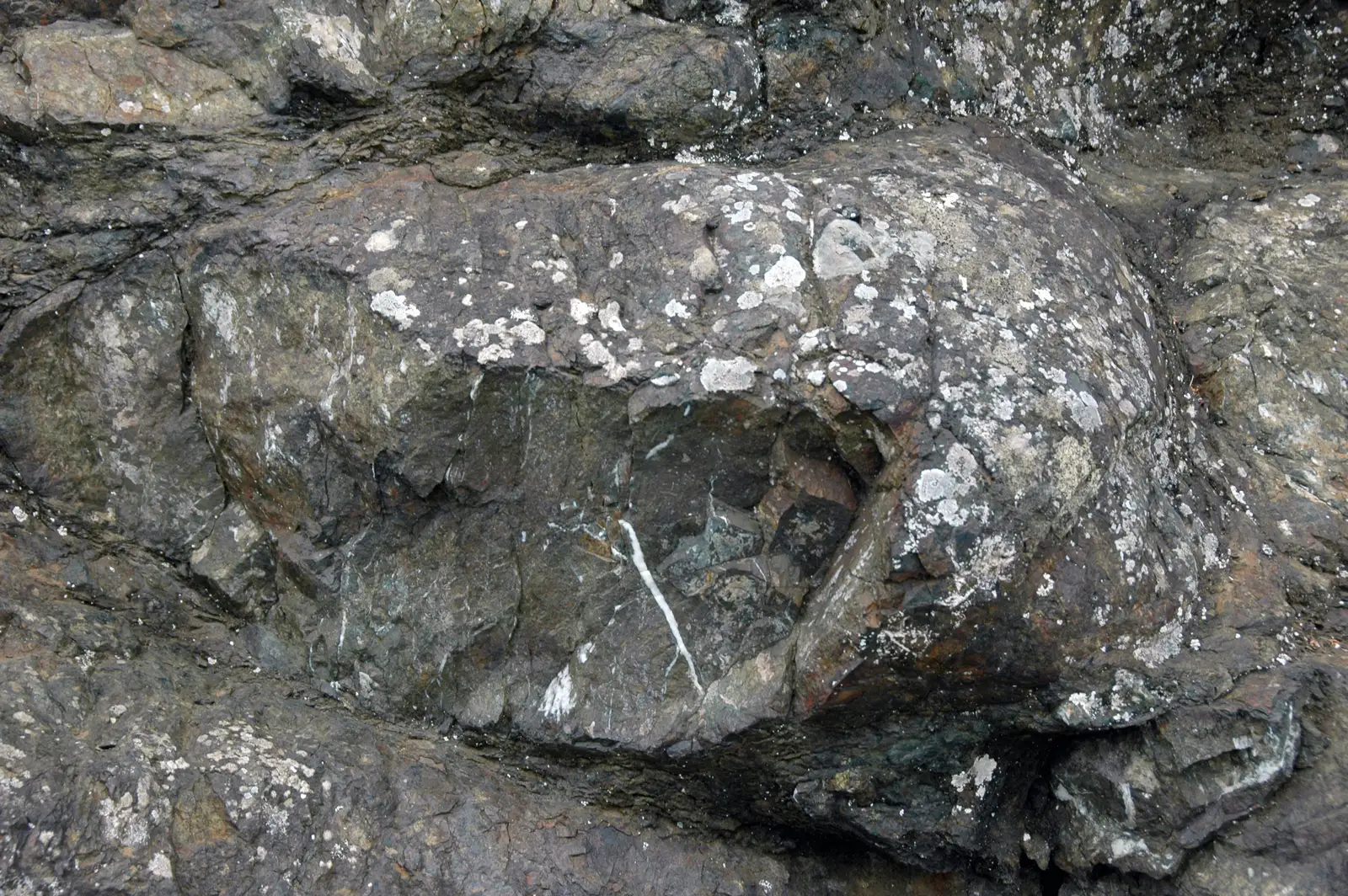
A pillow of basalt in the Franciscan Complex at Point Bonita, at the tip of the Marin Peninsula north of San Francisco.
"Pillow basalts (Franciscan Complex, Jurassic; Point Bonita, California, USA) 25" by James St. John — https://commons.wikimedia.org/wiki/File:Pillow_basalts_(Franciscan_Complex,_Jurassic;_Point_Bonita,_California,_USA)_25_(47262916441).jpg — CC BY 2.0 (https://creativecommons.org/licenses/by/2.0/)
At the Golden Gate, a 2001 USGS circular says the pillow basalts of the Marin Headlands “were originally formed on the ocean floor 150 to 100 million years ago.” The photo's description places this outcrop in the Franciscan Complex. The basalt there, it notes, has been changed into greenstone, a metamorphic rock, so these pillows began in the igneous branch of the rock cycle and have since moved into the metamorphic one. Point Bonita lies in Golden Gate National Recreation Area, where rocks are protected and taking rocks is prohibited.
Bubbles can be that second clue. A USGS page describes pillow basalts along the Hurricane Ridge Road in Olympic National Park, where, as in all national parks, taking rocks is prohibited. Their lack of bubbles, the page says, suggests the rock formed on the ocean floor under the pressure of deep water, because lava that cools on land or in shallow water “typically is rich in bubbles.”
Some pillows on land point only to a body of water. In Shenandoah National Park, Virginia, the USGS describes pillow basalts near Dark Hollow Falls. These pillows belong to the Catoctin Formation, lava flows from about 570 million years ago, and they “formed when lava flowed into a body of water.” Rocks in national parks are protected, and taking rocks is prohibited.
Six pillow lava sites compared
| Site | Setting | Age | Source |
|---|---|---|---|
| Galápagos Rift | Seafloor; collapsed pillow photographed in 2011 | Not given | NOAA photo, Commons file page |
| Mauna Loa, submerged west slope | Underwater flank of a volcano, about 2,500 feet deep | Not given | USGS, Eruptions of Hawaiian Volcanoes |
| Marin Headlands, California | On land; formed on the ocean floor | 150 to 100 million years ago | USGS Circular 1198 (2001) |
| Near Dark Hollow Falls, Shenandoah National Park | On land; lava flowed into a body of water | About 570 million years ago (Catoctin Formation flows) | USGS Shenandoah geology page |
| Hurricane Ridge Road, Olympic National Park | On land; lack of bubbles suggests it formed on the ocean floor under deep water | Not given for this outcrop | USGS photo description |
| Near the former Copco Lake, California | On land; lava entered a body of water, not the ocean | Not given | USGS California Volcano Observatory (2026) |
Pillow lava sites and their sources (CSV) (sources and license of this file) Data: Wikimedia Commons file page, Expl6426 - broken pillow lava.jpg (NOAA, public domain), description text, retrieved 2026-11-18; USGS, Eruptions of Hawaiian Volcanoes: Past, Present, and Future, General Interest Publication, page 38 (U.S. Government work), retrieved 2026-11-18; USGS Circular 1198 (2001), Chin and Graymer, Regional Setting of the Gulf of the Farallones, Figure 4 caption (U.S. Government work), retrieved 2026-11-18; USGS Geology and Ecology of National Parks, Geology of Shenandoah National Park (U.S. Government work), retrieved 2026-11-18; USGS Geology and Ecology of National Parks, media page 'A photo of basalt pillows' (text only; U.S. Government work), retrieved 2026-11-18; USGS California Volcano Observatory, A. Pivarunas, Don't try to have a pillow fight with these pillows! (29 July 2026; U.S. Government work), retrieved 2026-11-18; USGS California Volcano Observatory, media page 'Jointed pillow lava from a basalt flow near the former Copco Lake, California' (text only; U.S. Government work), retrieved 2026-11-18
The ridges where new ocean crust erupts are traced in seafloor spreading. For a rock that is itself a dense volcanic glass, usually rhyolite rather than basalt in composition, see obsidian.
Sources
- Robert I. Tilling, Christina Heliker and Thomas L. Wright, Eruptions of Hawaiian Volcanoes: Past, Present, and Future, U.S. Geological Survey General Interest Publication, online edition, page 38 (page updated 1 May 1997). pubs.usgs.gov/gip/hawaii/page38.htmlRead: full text (page 38)Text license: U.S. Government work (17 U.S.C. §105) (terms)
- U.S. Geological Survey, Volcano Hazards Program, "Volcano Hazards Program Glossary". www.usgs.gov/glossary/volcano-hazards-program-…Read: full text (Pillow lava and Obsidian entries used)Text license: U.S. Government work (17 U.S.C. §105) (terms)
- Anthony Pivarunas, "Don't try to have a pillow fight with these pillows!", California Volcano Monitor, U.S. Geological Survey California Volcano Observatory, 29 July 2026. www.usgs.gov/observatories/calvo/news/dont-try…Read: full textText license: U.S. Government work (17 U.S.C. §105) (terms)
- U.S. Geological Survey, California Volcano Observatory, "Jointed pillow lava from a basalt flow near the former Copco Lake, California", image page, 18 June 2025. www.usgs.gov/media/images/jointed-pillow-lava-…Read: full text (description)Text license: U.S. Government work (17 U.S.C. §105) (terms)
- W. Jacquelyne Kious and Robert I. Tilling, "Developing the theory", This Dynamic Earth: The Story of Plate Tectonics, online edition (U.S. Geological Survey), page last modified 11 July 2025. pubs.usgs.gov/gip/dynamic/developing.htmlRead: full textText license: U.S. Government work (17 U.S.C. §105) (terms)
- John L. Chin and Russell W. Graymer, "Regional Setting of the Gulf of the Farallones", in Chin, J., Ueber, E., Stauffer, P.H., and Hendley, J.W., eds., Beyond the Golden Gate: Oceanography, Geology, Biology, and Environmental Issues in the Gulf of the Farallones, U.S. Geological Survey Circular 1198 (2001), doi:10.3133/cir1198. pubs.usgs.gov/circ/c1198/chapters/021-036_Regio…Read: full text (chapter, including the Figure 4 caption on pages 32 to 33)Text license: U.S. Government work (17 U.S.C. §105) (terms)
- U.S. Geological Survey, Geology and Ecology of National Parks, "A photo of basalt 'pillows'", image page (Olympic National Park). www.usgs.gov/media/images/a-photo-basalt-pillowsRead: full text (description)Text license: U.S. Government work (17 U.S.C. §105) (terms)
- U.S. Geological Survey, Geology and Ecology of National Parks, "Geology of Shenandoah National Park". www.usgs.gov/geology-and-ecology-of-national-p…Read: full textText license: U.S. Government work (17 U.S.C. §105) (terms)
Cite this page
Strata & Seafloor. “Pillow Lava: A Glassy Rind Forms Where Lava Meets Water.” First published November 18, 2026. https://strataandseafloor.com/seafloor/pillow-lava/. Accessed on the day you read it.
How ages and sources are checkedAll correctionsReport an error on this page (contact@strataandseafloor.com)
Also in Seafloor
SF Reading the evidence
Seafloor Spreading: Magnetic Stripes Mirror Across the Ridge
Filed
Picture credit
"Bathymetric chart of the North Atlantic, by Matthew Fontaine Maury" by Matthew Fontaine Maury — https://commons.wikimedia.org/wiki/File:Maury_1854_Bathymetric_Chart_pl23_map00002.jpg — Public Domain (US: published 1854, before 1931, so out of copyright by age; also a U.S. Government work (17 U.S.C. §105) by U.S. Navy Lieutenant Matthew Fontaine Maury in his official duties, the plate engraved and printed by J. M. Butler, Philadelphia (contractor; covered by the publication-date basis); EU: author d. 1873, published 1854 (engraver's death year not traced; for an 1854 plate, death before 1956 is practically certain, as accepted for the 1832 Lyell plate); upstream not traced)
SF Reading the evidence
Hydrothermal Vents: Found Where Geologists Expected Heat
Filed
Picture credit
"Black smoker at a mid-ocean ridge hydrothermal vent, Atlantic Ocean" by P. Rona / OAR/National Undersea Research Program (NURP); NOAA — https://commons.wikimedia.org/wiki/File:Blacksmoker_in_Atlantic_Ocean.jpg — Public Domain (US: U.S. Government work (17 U.S.C. §105), NOAA photo by P. Rona, OAR/National Undersea Research Program, taken as part of an employee's official duties per the file page; EU: no statutory public-domain basis, agency public-domain marking; upstream not traced)
SF Field entry
Continental Shelf: Much of It Was Dry Land in the Ice Age
Filed
Picture credit
"Continental shelf off the Golden Gate, San Francisco, California true-color composite, Sentinel-2 L2A scene S2B_T10SEG_20250324T190338_L2A via Earth Search (Element 84)" by Strata & Seafloor — https://earth-search.aws.element84.com/v1/collections/sentinel-2-c1-l2a/items/S2B_T10SEG_20250324T190338_L2A — Copernicus Sentinel data legal notice (https://sentinels.copernicus.eu/documents/247904/690755/Sentinel_Data_Legal_Notice); modified: cropped, resampled, color-stretched; rights notice: Contains modified Copernicus Sentinel data 2025