Comparison and scale list
Rock Cycle: Any Rock Type Can Become Any Other
Strata & Seafloor Filed
The short answer
Any rock type can become any other: a USGS teaching page says “any rock can become another rock, and that is the rock cycle.” Erosion breaks rock into sediment that can later become sedimentary rock, heat and pressure make metamorphic rock, and melted rock cools into igneous rock. The same page says the cycle has no single starting point and many possible pathways.
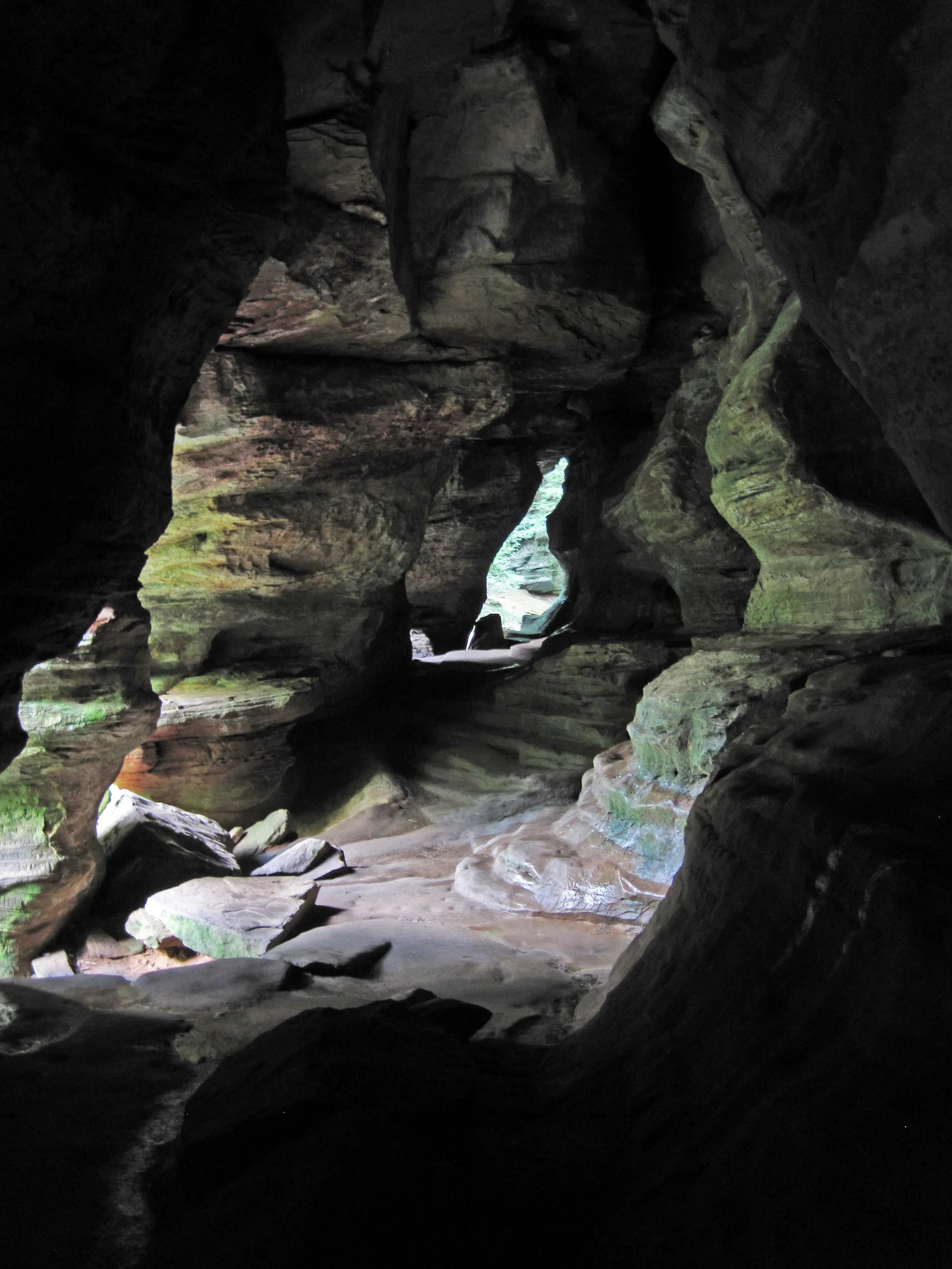
Rock House in the Hocking Hills of Ohio, a hollow worn into the Black Hand Sandstone along cracks in the rock.
"Black Hand Sandstone (Lower Mississippian; Rock House, Hocking Hills, Ohio, USA) 2" by James St. John — https://commons.wikimedia.org/wiki/File:Black_Hand_Sandstone_(Lower_Mississippian;_Rock_House,_Hocking_Hills,_Ohio,_USA)_2.jpg — CC BY 2.0 (https://creativecommons.org/licenses/by/2.0/)
A granite curb is igneous rock, and the sand swept against it is sediment that could one day become sandstone. In the USGS description, granite is magma that cooled slowly underground, and erosion breaks rocks into sediment that can later become sedimentary rock, so getting from one to the other takes a single step.
The sandstone in the photo is partway back to sediment. The photographer’s file description says Rock House formed by “differential erosion of sandstones” along cracks called joints, so grains once cemented into rock are being worn loose again.
What are the three types of rocks?
The USGS teaching page sorts rocks into three basic types by how they form. Igneous rocks come from melted rock, magma or lava. Sedimentary rocks are made of particles of other rocks and are often layered. Metamorphic rocks have changed under high heat and pressure deep in the Earth, and they are commonly layered or foliated, with minerals lined up in bands.
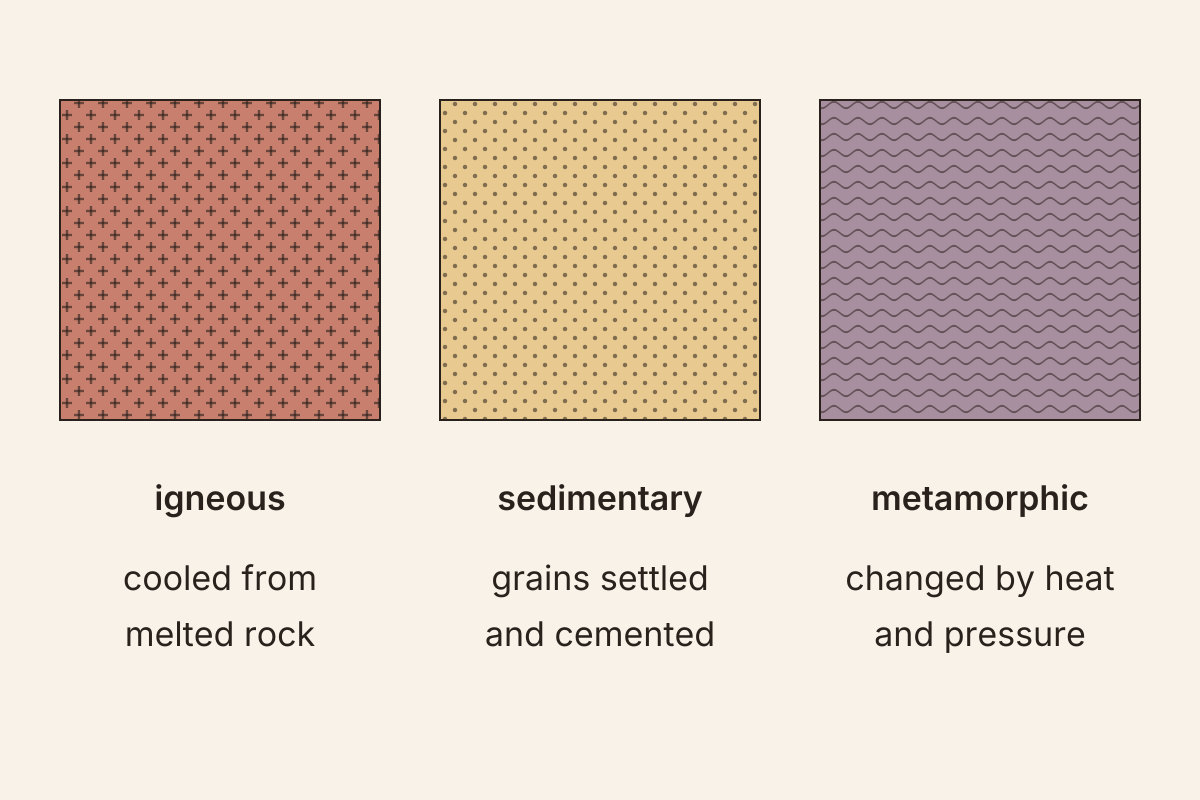
The three rock types as texture symbols, each with how it forms.
Evidence Definitions from the USGS teaching page cited below; the swatches use this site’s own fill symbols, not a mapping standard.
"The three rock types and how each forms" by Strata & Seafloor, https://strataandseafloor.com/rocks-minerals/rock-cycle/, licensed under CC BY 4.0 (https://creativecommons.org/licenses/by/4.0/)
Data: USGS Educational Resources, What's New? Weeks 9-12 (U.S. Government work), retrieved 2026-11-18
| Type | How it forms | Typical texture | Example | Easy to confuse with |
|---|---|---|---|---|
| Igneous | Melted rock cools: magma underground or lava at the surface | Large crystals if cooled slowly; fine grains or glass if cooled fast | Granite (slow), basalt (fast) | None named in the sources read |
| Sedimentary | Gravel, sand and mud settle, pile up and become rock | Grains, often in layers | Sandstone, mudstone | Layered metamorphic rock (both often layered) |
| Metamorphic | Heat and pressure change an existing rock | Minerals lined up in sheets or bands | Schist, gneiss | Layered sedimentary rock (both often layered) |
Download the three rock types compared (CSV) (sources and license of this file) Data: USGS Educational Resources, What's New? Weeks 9-12 (U.S. Government work), retrieved 2026-11-18; USGS, Fossils, Rocks, and Time: Rocks and Layers (U.S. Government work), retrieved 2026-11-18; National Park Service, Metamorphic Rocks and Vishnu Basement Rocks (U.S. Government works; No protection is claimed in original U.S. Government works), retrieved 2026-11-18
Which type is most common depends on where the count is made. A USGS general-interest page on rocks and layers says “most of the rocks exposed at the surface of Earth are sedimentary,” formed from pieces of older rocks broken apart by water or wind. An abstract on a USGS publication record (Gilluly, Reed and Cady, 1970) put the rock exposed to erosion across the contiguous United States at about 76 percent sedimentary and 24 percent igneous.
How does one rock turn into another?
The USGS page traces one route, from igneous to sedimentary to metamorphic to magma and back, but calls it one of “many possible pathways.” Its own steps allow shortcuts. Heat and pressure act on “sedimentary or igneous rocks,” so igneous rock can turn metamorphic without first becoming sediment, and “even more heat can melt any kind of rock.”
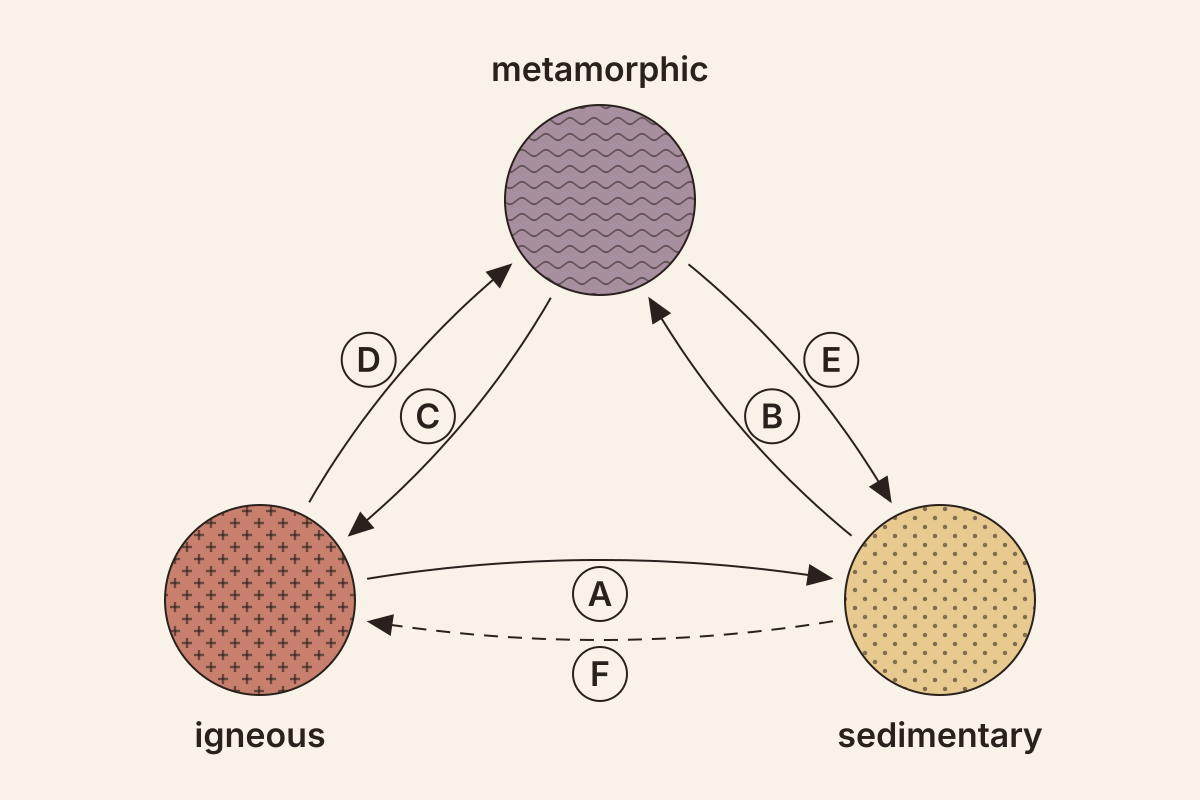
Six one-way paths among the three rock types; the dashed path has no named example in the sources read for this page.
Evidence Each path rests on the USGS teaching page, and each Grand Canyon example on the NPS Vishnu Basement Rocks page, both cited below; the dashed path rests only on the USGS statement that heat can melt any kind of rock.
Key to the letters and numbers
- A igneous to sedimentary: erosion breaks rock into sediment; zircon, a mineral that often forms in igneous rock, survives as grains in the once-sedimentary Vishnu Schist
- B sedimentary to metamorphic: heat and pressure; the Vishnu Schist began as sedimentary rock
- C metamorphic to igneous: melting; Grand Canyon granites formed by crustal melting 1,698 to 1,662 million years ago
- D igneous to metamorphic: heat and pressure; the Brahma and Rama schists began as volcanic rock
- E metamorphic to sedimentary: erosion; the Vishnu mountains were worn down before new sediment covered them
- F sedimentary to igneous: melting; no named example in the sources read
"Six one-way paths among the three rock types" by Strata & Seafloor, https://strataandseafloor.com/rocks-minerals/rock-cycle/, licensed under CC BY 4.0 (https://creativecommons.org/licenses/by/4.0/)
Data: USGS Educational Resources, What's New? Weeks 9-12 (U.S. Government work), retrieved 2026-11-18; National Park Service, Vishnu Basement Rocks (U.S. Government work; No protection is claimed in original U.S. Government works), retrieved 2026-11-18
Sedimentary rock can also skip both other types. The Gilluly abstract judged that most sediment now eroding from the contiguous United States is “recycled rather than first-cycle sediment,” worn from older sedimentary rock and laid down again. Not every sedimentary rock is made of grains, either: the NPS also counts chemical precipitates such as calcium carbonate. Minerals that grow inside a hollow in rock are the subject of how geodes form.
Igneous rocks: cooled from melt
How fast the melt cooled can be read in igneous rock. In the USGS description, magma that cools slowly underground grows crystals large enough to see, as in granite or gabbro. Lava that cools quickly at the surface leaves minerals generally too small to see without a microscope, as in basalt, and sometimes lava cools so fast that it makes volcanic glass, obsidian.
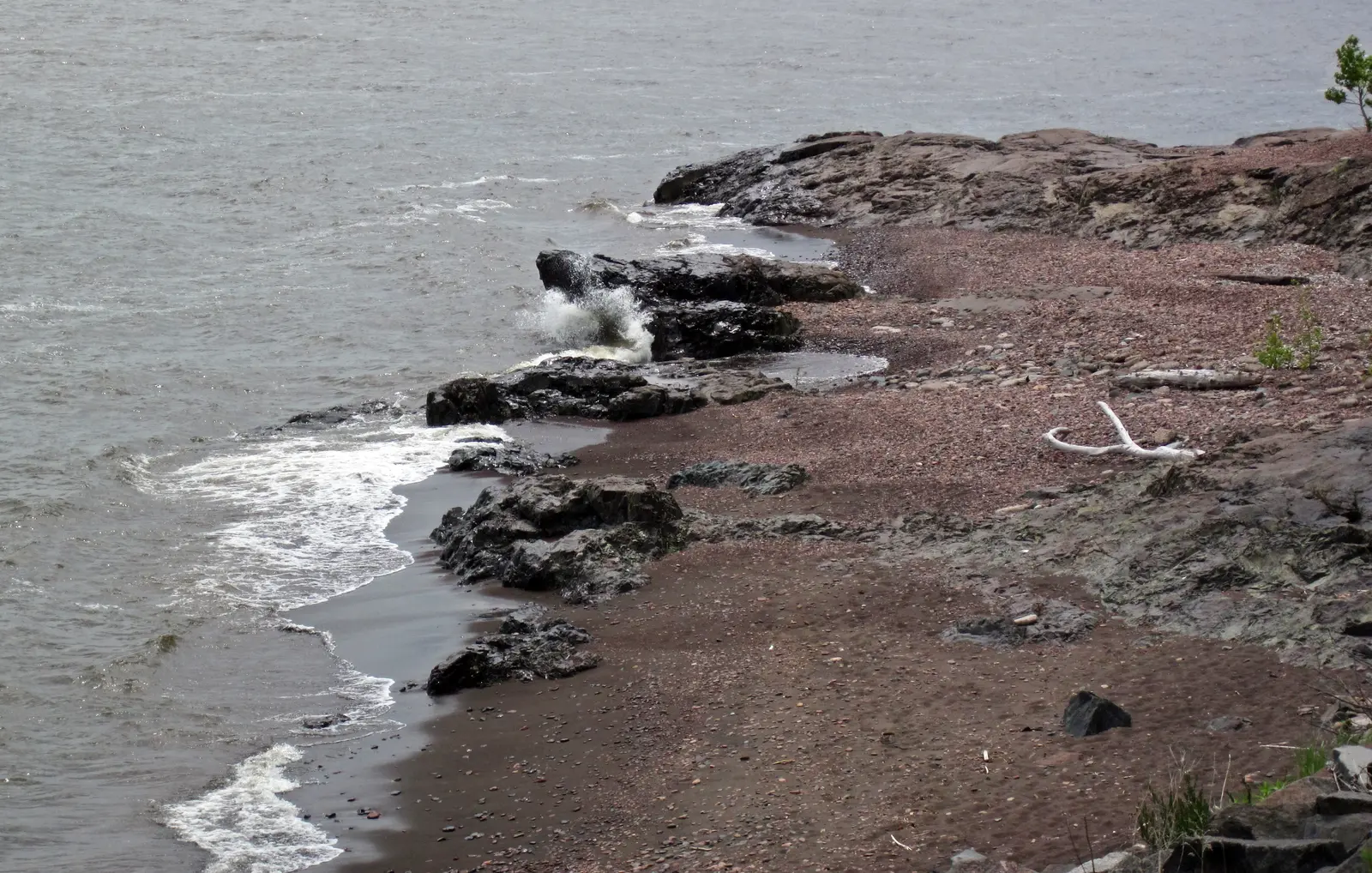
Basalt lava flows about 1.1 billion years old on the Lake Superior shore near Duluth, Minnesota.
"Basalt lava flows (North Shore Volcanic Group, Mesoproterozoic, ~1.1 Ga; Lake Superior shoreline exposure along the North Shore Scenic Railroad line, just northeast of Duluth, Minnesota, USA) 2" by James St. John — https://commons.wikimedia.org/wiki/File:Basalt_lava_flows_(North_Shore_Volcanic_Group,_Mesoproterozoic,_~1.1_Ga;_Lake_Superior_shoreline_exposure_along_the_North_Shore_Scenic_Railroad_line,_just_northeast_of_Duluth,_Minnesota,_USA)_2_(22129543978).jpg — CC BY 2.0 (https://creativecommons.org/licenses/by/2.0/)
The photographer’s file description places these flows in the North Shore Volcanic Group, basalt lava flows plus minor sedimentary rocks that filled an ancient rift valley. Rock exposed at a shoreline like this one is open to erosion. That is the first step on path A.
Sedimentary and metamorphic rocks: one canyon wall
The Grand Canyon’s lowest rocks have been along several of these paths. The NPS dates the Vishnu, Brahma and Rama schists to about 1,750 million years ago. The Brahma and Rama began as volcanic rocks and the Vishnu as sedimentary rocks, and all three were metamorphosed when buried up to 20 km (12 miles) deep during a mountain-building event, the Yavapai orogeny, approximately 1,700 million years ago.
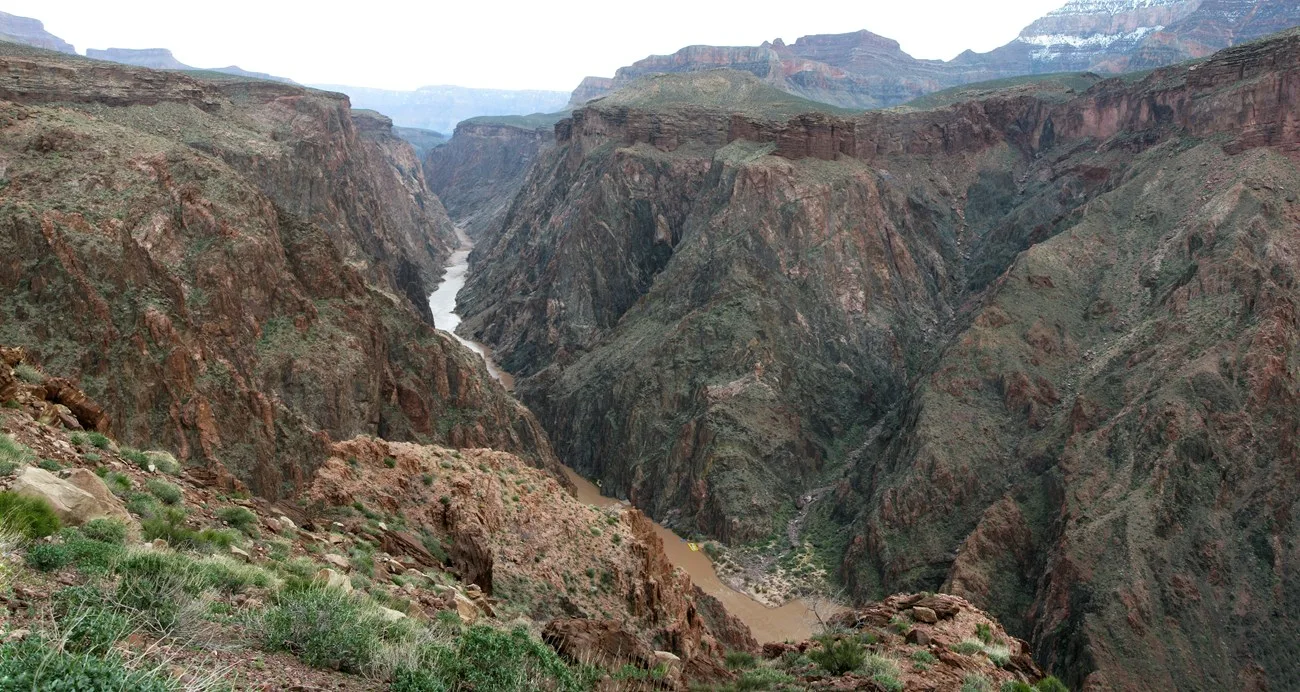
"The inner gorge of the Grand Canyon and the Colorado River" by NPS Photo by Michael Quinn — https://www.nps.gov/articles/000/grcatime-vishnu-basement-rocks.htm — Public Domain (US: U.S. Government work (17 U.S.C. §105), credited NPS Photo by Michael Quinn on the NPS page; EU: no statutory public-domain basis, agency public-domain marking. No protection is claimed in original U.S. Government works)
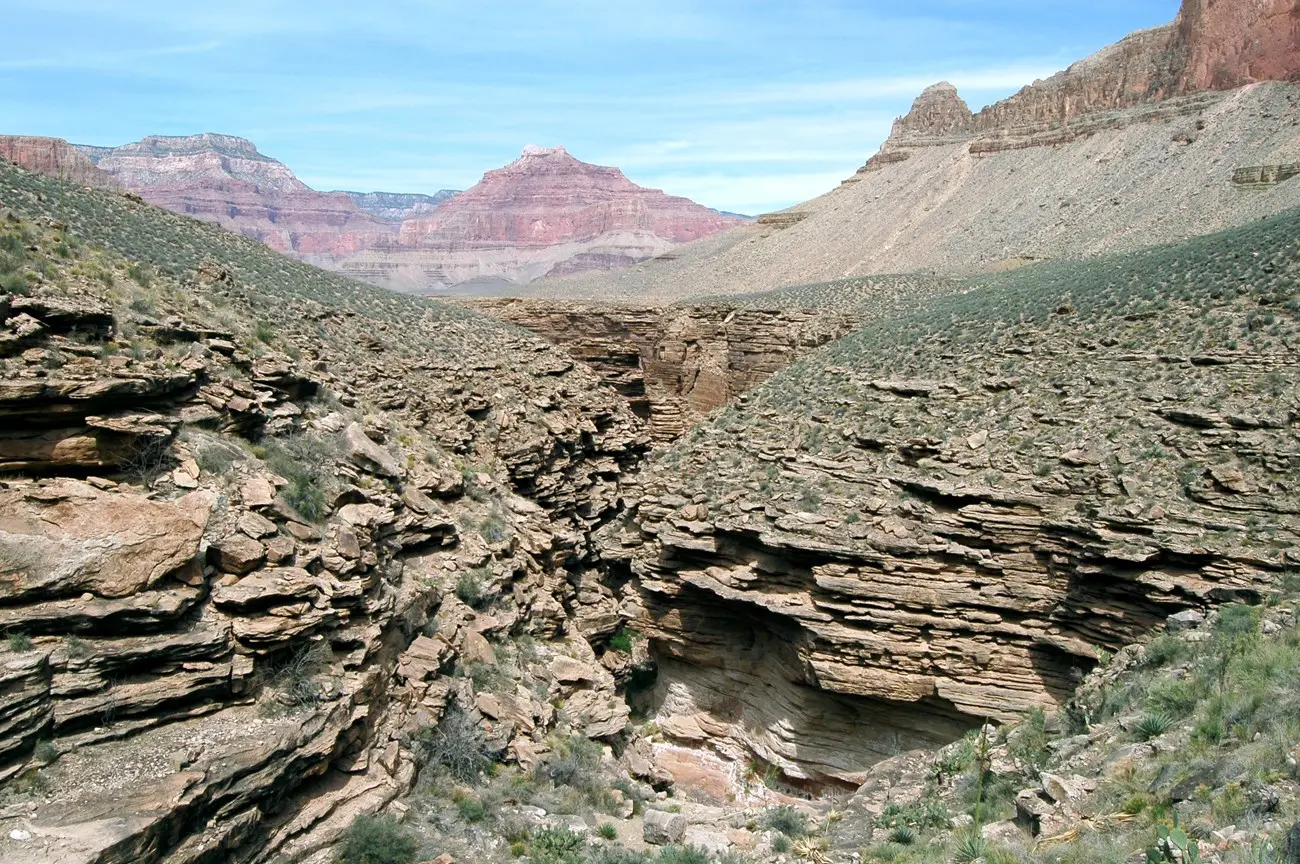
"Tapeats sandstone ledges above Salt Creek, from the Tonto Trail" by NPS Photo by Michael Quinn — https://www.nps.gov/articles/000/grcatime-layered-paleozoic-rock.htm — Public Domain (US: U.S. Government work (17 U.S.C. §105), credited NPS Photo by Michael Quinn on the NPS page; EU: no statutory public-domain basis, agency public-domain marking. No protection is claimed in original U.S. Government works)
First, the inner gorge of the Grand Canyon, home of the Vishnu Basement Rocks in the NPS account; second, Tapeats Sandstone ledges above Salt Creek.
Later granites formed from crustal melting during the same collisions, path C, and then the mountains were worn down. The Tapeats Sandstone, about 508 million years old, formed on sandy beaches and river bottoms. Where the Tonto Group it belongs to lies on the Vishnu Basement Rocks, the NPS calls the erosional contact the Great Unconformity. Rocks in national parks are protected, and taking rocks is prohibited.
Can a rock be more than one type? The USGS page defines each type by how the rock formed, so the Vishnu Schist counts as metamorphic. Its earlier life still shows.
The USGS calls the starting rock the protolith, and the NPS describes the Vishnu rocks as metavolcanic and metasedimentary. The NPS also notes that zircon grains in the Vishnu Schist kept ages as old as 3.8 billion years through metamorphism, ages of the sediment source rather than of the schist.
How long does the rock cycle take?
There is no single answer: the USGS page says only that the rock cycle is like the water cycle but “much, much slower,” and single steps take very different amounts of time. At Mount Rainier, a USGS educator’s guide says a black glassy andesite “cooled in just seconds,” while gray andesite cooled “within days to years.” Both formed inside Mount Rainier National Park, where rocks are protected and taking rocks is prohibited.
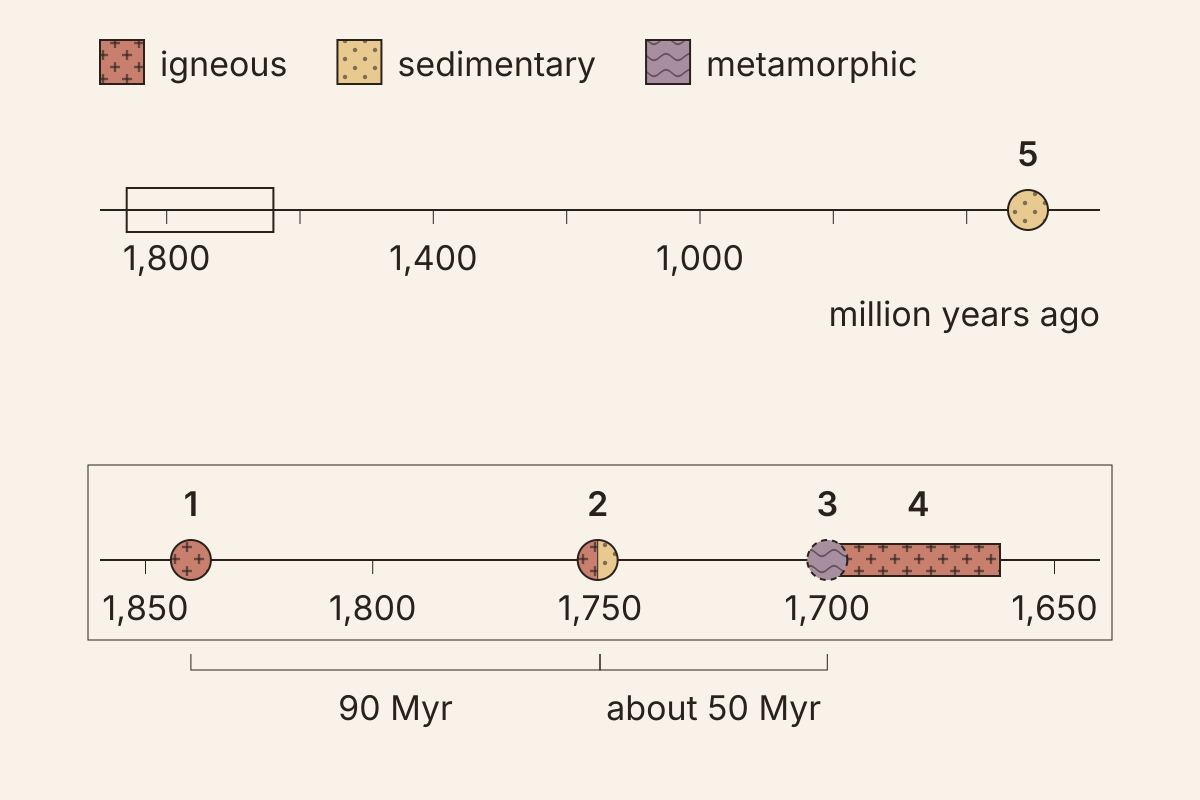
One sourced path through the cycle in the Grand Canyon’s oldest rocks, by NPS ages.
Evidence Ages from the NPS Vishnu Basement Rocks and Layered Paleozoic Rocks pages (2020 update); spans are differences of those ages.
Key to the letters and numbers
- 1 Elves Chasm pluton, igneous, 1,840 million years ago
- 2 volcanic and sedimentary rocks of the Granite Gorge Metamorphic Suite, 1,751 to 1,750 million years ago
- 3 Yavapai orogeny metamorphoses them, approximately 1,700 million years ago
- 4 later granites from crustal melting, 1,698 to 1,662 million years ago
- 5 Tapeats Sandstone laid down, about 508 million years ago
"One path through the rock cycle in the Grand Canyon's oldest rocks" by Strata & Seafloor, https://strataandseafloor.com/rocks-minerals/rock-cycle/, licensed under CC BY 4.0 (https://creativecommons.org/licenses/by/4.0/)
Data: National Park Service, Vishnu Basement Rocks and Layered Paleozoic Rocks (U.S. Government works; No protection is claimed in original U.S. Government works), retrieved 2026-11-18
Slower steps can be read from those NPS ages. An unconformity of 90 million years separates the Elves Chasm pluton, 1,840 million years old, from the volcanic and sedimentary rocks laid on it. That is a gap in the record, not one step. Those rocks were metamorphosed approximately 1,700 million years ago, about 50 million years after the ages the NPS gives for them.
Dune sand takes its own path to rock: the Coconino Sandstone, about 280 million years old by NPS ages, began as desert dune fields, like the ones described in sand dunes.
The rock identification key sorts a rock in hand into one of the three types, and Grand Canyon rock layers reads all three in one canyon wall.
Sources
- U.S. Geological Survey Educational Resources, "What's New? Weeks 9-12" (Week 12: Rocks and Minerals). www.usgs.gov/educational-resources/whats-new-w…Read: full textText license: U.S. Government work (17 U.S.C. §105) (terms)
- James St. John, "Black Hand Sandstone (Lower Mississippian; Rock House, Hocking Hills, Ohio, USA) 2", file description on Wikimedia Commons, 2017, CC BY 2.0. commons.wikimedia.org/wiki/File:Black_Hand_Sandstone_(L…Read: file page (description and license)Text license: CC BY 2.0 (terms)
- U.S. Geological Survey, "Rocks and Layers", Fossils, Rocks, and Time (general interest publication, page last updated 14 August 1997). pubs.usgs.gov/gip/fossils/rocks-layers.htmlRead: full textText license: U.S. Government work (17 U.S.C. §105) (terms)
- James Gilluly, John C. Reed and Wallace M. Cady, "Sedimentary volumes and their significance", Bulletin of the Geological Society of America 81 (1970): 353 (abstract on the USGS record page). www.usgs.gov/publications/sedimentary-volumes-…Read: abstract only (USGS Publications Warehouse record page)Text license: USGS publication record page: U.S. Government work (17 U.S.C. §105); the Bulletin of the Geological Society of America (1970) article it describes is cited for facts, not reproduced (terms)
- U.S. National Park Service, "Vishnu Basement Rocks", Telling Time at Grand Canyon National Park series (2020 update), Table 2. www.nps.gov/articles/000/grcatime-vishnu-base…Read: full textText license: U.S. Government work. No protection is claimed in original U.S. Government works (terms)
- National Park Service, "Metamorphic Rocks" (Geology). www.nps.gov/subjects/geology/metamorphic.htmRead: full textText license: U.S. Government work. No protection is claimed in original U.S. Government works (terms)
- James St. John, "Basalt lava flows (North Shore Volcanic Group, Mesoproterozoic, ~1.1 Ga; Lake Superior shoreline exposure ... northeast of Duluth, Minnesota, USA) 2", file description on Wikimedia Commons, 2015, CC BY 2.0. commons.wikimedia.org/wiki/File:Basalt_lava_flows_(Nort…Read: file page (description and license)Text license: CC BY 2.0 (terms)
- U.S. National Park Service, "Layered Paleozoic Rocks", Telling Time at Grand Canyon National Park series (2020 update), Table 8. www.nps.gov/articles/000/grcatime-layered-pal…Read: full textText license: U.S. Government work. No protection is claimed in original U.S. Government works (terms)
- National Park Service, "Missing Time at Grand Canyon National Park", Telling Time at Grand Canyon series, with glossary of geologic terms (last updated 30 January 2024). www.nps.gov/articles/000/grcatime-missing-tim…Read: full textText license: U.S. Government work. No protection is claimed in original U.S. Government works (terms)
- U.S. Geological Survey, "Rock Stars", in Living with a Volcano in Your Backyard: An Educator's Guide with Emphasis on Mount Rainier, General Information Product 19 (prepared in collaboration with the National Park Service; activity last modified November 21, 2014). pubs.usgs.gov/gip/19/downloads/Chapter_2/Activi…Read: full textText license: U.S. Government work (17 U.S.C. §105) (terms)
- U.S. Geological Survey, "Age of the Earth", Geologic Time (online edition, last updated July 9, 2007). pubs.usgs.gov/gip/geotime/age.htmlRead: full textText license: U.S. Government work (17 U.S.C. §105) (terms)


Cite this page
Strata & Seafloor. “Rock Cycle: Any Rock Type Can Become Any Other.” First published November 18, 2026. https://strataandseafloor.com/rocks-minerals/rock-cycle/. Accessed on the day you read it.
How ages and sources are checkedAll correctionsReport an error on this page (contact@strataandseafloor.com)
Also in Rocks & Minerals
RM Interactive or diagram page
Rock Identification: Look at Grain Size Before Color
Filed
Picture credit
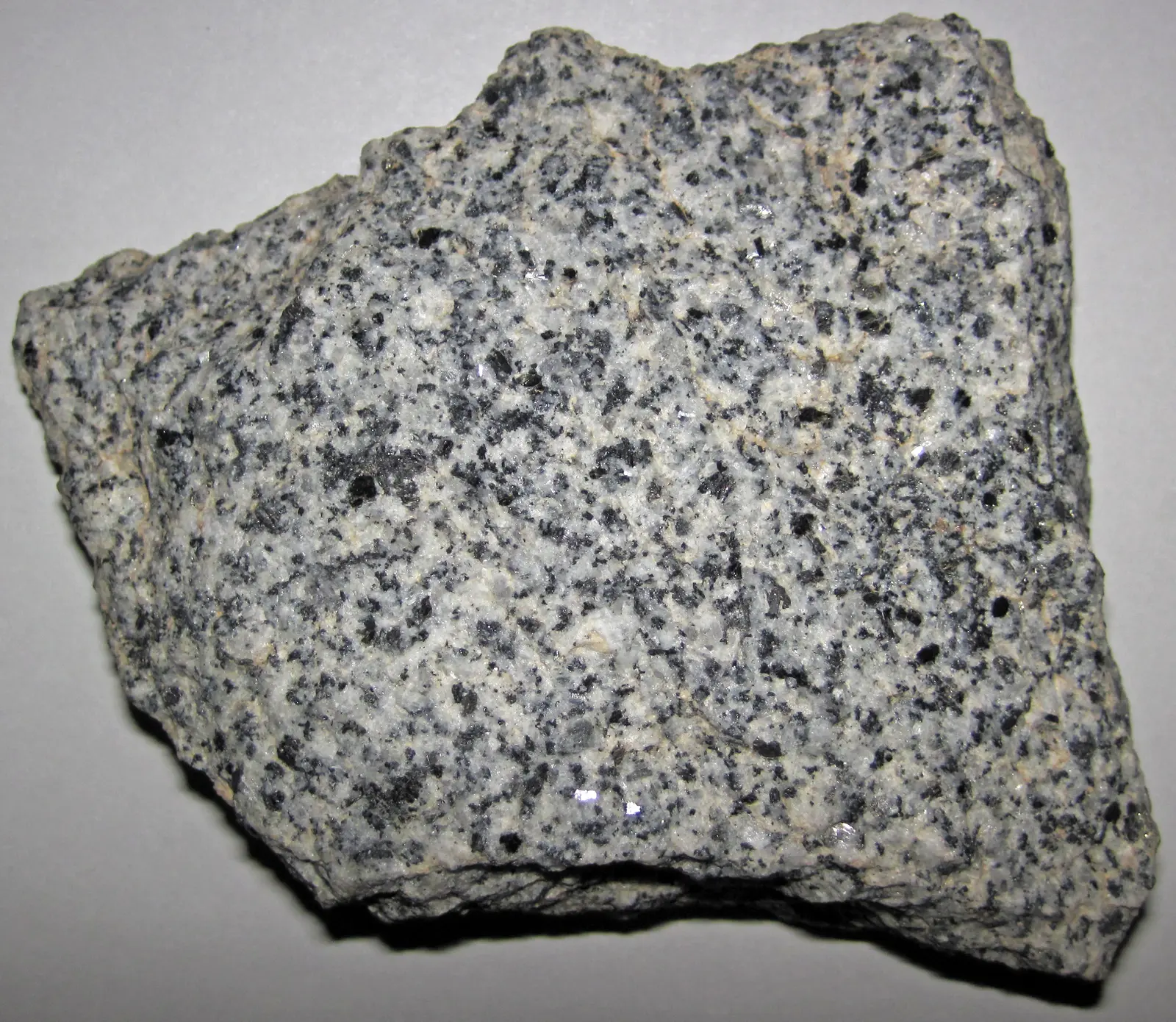
"Granite or granodiorite (Sierra Nevada Batholith, Early Cretaceous)" by James St. John — https://commons.wikimedia.org/wiki/File:Granite_or_granodiorite_(Sierra_Nevada_Batholith,_Early_Cretaceous;_Lower_Rock_Creek_Road,_near_Bishop,_California,_USA)_(30715327533).jpg — CC BY 2.0 (https://creativecommons.org/licenses/by/2.0/)
RM Comparison and scale list
Mohs Hardness Scale: The Steps Are Ranks, Not Equal Units
Filed
Picture credit
"Portrait of Friedrich Mohs, lithograph, 1832" by Kriehuber (artist); Gebr. Mansfeld & Comp. (printer) — https://commons.wikimedia.org/wiki/File:Friedrich_Mohs_portrait_by_Kriehuber_1832.jpg — Public Domain (US: published 1832, before January 1, 1931; EU: artist Kriehuber d. 1876 (Commons marks the file PD-old-100 and Public Domain Mark 1.0); faithful reproduction of a two-dimensional work)
RM Field entry
Geodes: Formed in Hollows, Then Lined From the Outside In
Filed
Picture credit
"Quartz-barite-calcite geode" by James St. John — https://commons.wikimedia.org/wiki/File:Quartz-barite-calcite_geode_(Rt._37_roadcut,_Harrodsburg,_Indiana,_USA)_(33656807910).jpg — CC BY 2.0 (https://creativecommons.org/licenses/by/2.0/); modified: cropped