Interactive or diagram page
Rock Identification: Look at Grain Size Before Color
Strata & Seafloor Filed
The short answer
Rock identification works better from grain size than color. A USGS teaching page warns that color is not a reliable way to identify most minerals, while grain size and arrangement record how a rock formed: slowly cooled magma, quickly cooled lava, settled sand or mud, or minerals squeezed into bands. This key stops at a rock class or common rock name.
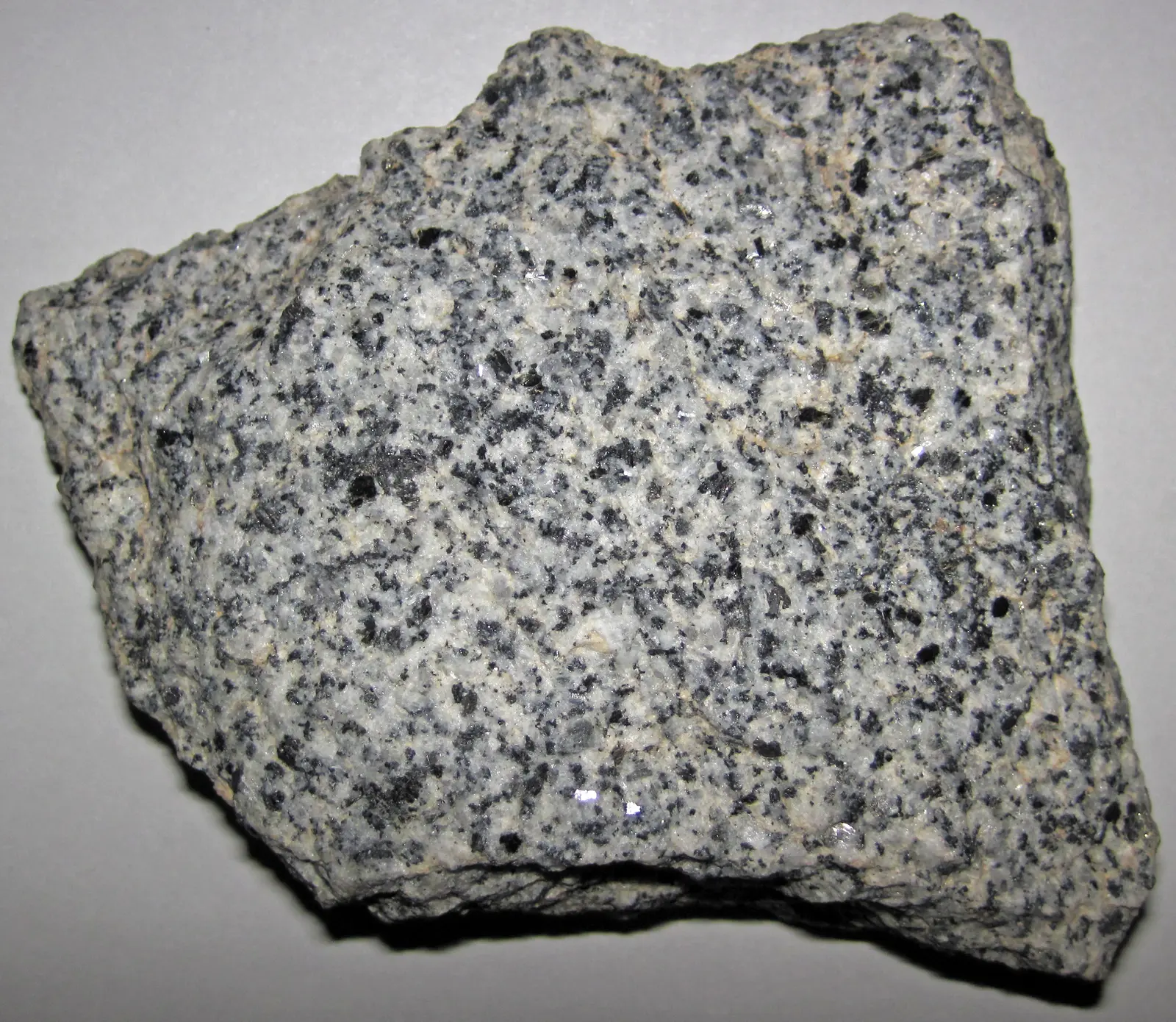
A hand specimen labeled granite or granodiorite from the Sierra Nevada Batholith of California, about 8.8 cm across at its widest.
"Granite or granodiorite (Sierra Nevada Batholith, Early Cretaceous)" by James St. John — https://commons.wikimedia.org/wiki/File:Granite_or_granodiorite_(Sierra_Nevada_Batholith,_Early_Cretaceous;_Lower_Rock_Creek_Road,_near_Bishop,_California,_USA)_(30715327533).jpg — CC BY 2.0 (https://creativecommons.org/licenses/by/2.0/)
Under a hand lens, a gray Sierra Nevada granite or granodiorite splits into separate grains of white, gray and black. The gray is only a blend of those grains. Their size says more: in the USGS description, crystals this large grow in magma that cools slowly underground. The photo’s file description places the rock in a batholith of “old, cooled magma chambers.”
Step through the rock key
The key asks up to two questions about what is visible. The first sorts a rock toward the three types the USGS defines by how they form: igneous, sedimentary and metamorphic. Each answer names the USGS or NPS page it rests on. This page does not appraise, authenticate or price specimens.
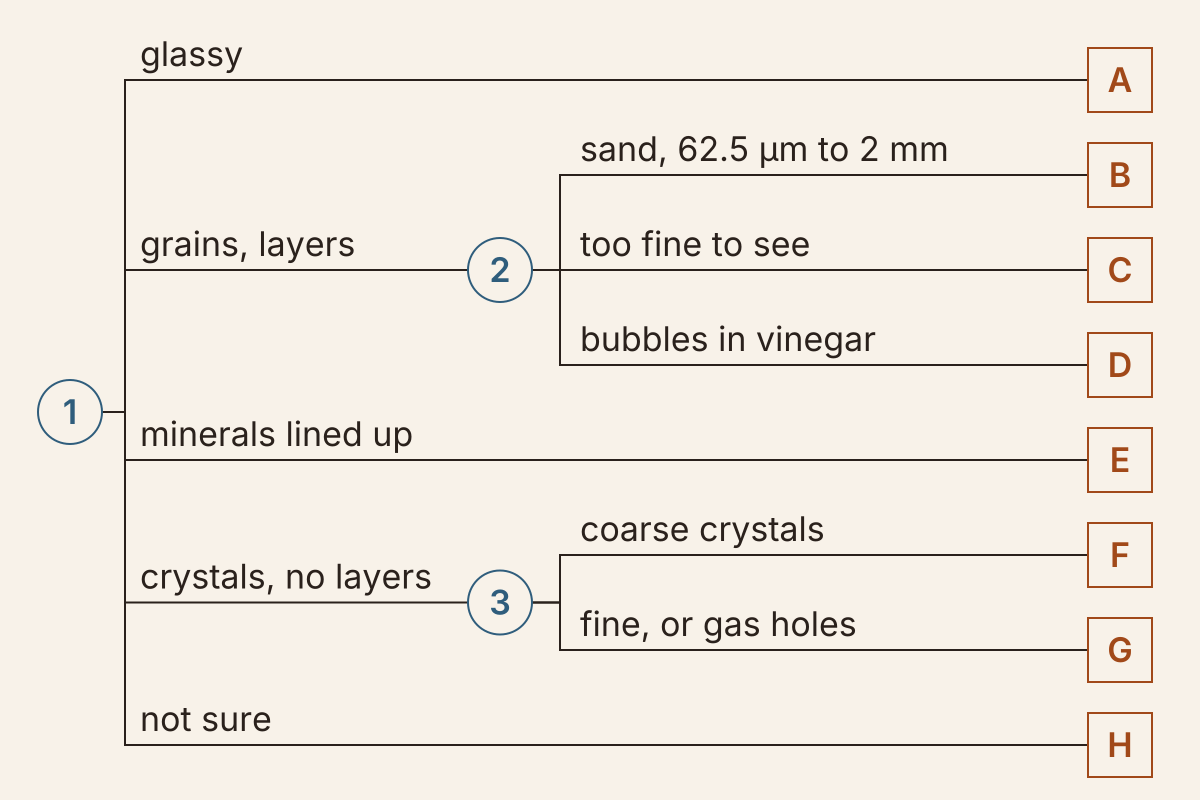
The rock key as a printable tree: three questions and eight end points.
Evidence Every branch rests on a USGS or NPS page listed under Sources; the interactive key reads the downloadable table, which passes a check for loops, dead ends and questions that cannot be reached.
Key to the letters and numbers
- 1 What does the rock's surface show under a hand lens?
- 2 Which description fits the grains best?
- 3 What do the crystals look like?
- A obsidian
- B sandstone
- C mudstone
- D limestone
- E foliated metamorphic rock
- F intrusive igneous rock
- G extrusive igneous rock
- H not identified here; “not sure” at question 2 or 3 also ends here
"Rock key from what the surface shows to a likely rock class" by Strata & Seafloor, https://strataandseafloor.com/rocks-minerals/rock-identification/, licensed under CC BY 4.0 (https://creativecommons.org/licenses/by/4.0/)
Data: USGS Educational Resources, What's New? Weeks 9-12 (U.S. Government work), retrieved 2026-11-18; USGS General Information Product 19, Rock Stars (U.S. Government work), retrieved 2026-11-18; USGS Open-File Report 2006-1195, Nomenclature (U.S. Government work), retrieved 2026-11-18; National Park Service, Metamorphic Rocks and Make a Cave (U.S. Government works; No protection is claimed in original U.S. Government works), retrieved 2026-11-18; USGS FAQ, Can you identify my rock or mineral? (U.S. Government work), retrieved 2026-11-18
The whole key, question by question:
What does the rock's surface show under a hand lens?
- Smooth glass with no grains at allUSGS: lava sometimes cools so fast that it makes volcanic glass (obsidian); grains had no time to grow; USGS Educational Resources, What's New? Weeks 9-12 (Week 12, Rocks and Minerals); https://www.usgs.gov/educational-resources/whats-new-weeks-9-12 | USGS General Information Product 19, Rock Stars activity (prepared with the National Park Service); https://pubs.usgs.gov/gip/19/downloads/Chapter_2/Activities/Rock%20Stars.pdf
Likely: obsidian
- Grains of sand or mud packed together, often in layersUSGS: sedimentary rocks are made of particles of other rocks and are often layered; USGS Educational Resources, What's New? Weeks 9-12 (Week 12, Rocks and Minerals); https://www.usgs.gov/educational-resources/whats-new-weeks-9-12
Which description fits the grains best?
- Sand grains you can see, 62.5 µm to 2 mm acrossUSGS: sandstone is a rock that formed from sand; on the Wentworth scale sand is under 2 mm and over 62.5 µm; USGS Educational Resources, What's New? Weeks 9-12 (Week 12, Rocks and Minerals); https://www.usgs.gov/educational-resources/whats-new-weeks-9-12 | USGS Open-File Report 2006-1195, Nomenclature (Wentworth grade scale); https://pubs.usgs.gov/of/2006/1195/htmldocs/nomenclature.htm
Likely: sandstone
- Too fine to see, smooth like hardened mudUSGS: mudstone is a rock that formed from mud; mud is silt plus clay, finer than 62.5 µm; USGS Educational Resources, What's New? Weeks 9-12 (Week 12, Rocks and Minerals); https://www.usgs.gov/educational-resources/whats-new-weeks-9-12 | USGS Open-File Report 2006-1195, Nomenclature (Wentworth grade scale); https://pubs.usgs.gov/of/2006/1195/htmldocs/nomenclature.htm
Likely: mudstone
- Bubbles under a drop of white vinegarNPS: limestone bubbles under white vinegar as it dissolves and releases carbon dioxide; USGS: limestone is made of calcite; NPS Wind Cave National Park, Make a Cave; https://www.nps.gov/wica/learn/education/make-a-cave.htm | USGS Educational Resources, What's New? Weeks 9-12 (Week 12, Rocks and Minerals); https://www.usgs.gov/educational-resources/whats-new-weeks-9-12
Likely: limestone
- Not sureUSGS: rocks must be examined in person; it suggests a state geological survey, a natural science museum or a university geology department; USGS FAQ, Can you identify my rock or mineral?; https://www.usgs.gov/faqs/can-you-identify-my-rock-or-mineral
Likely: not identified here: a state geological survey or natural science museum can examine it
- Sand grains you can see, 62.5 µm to 2 mm acrossUSGS: sandstone is a rock that formed from sand; on the Wentworth scale sand is under 2 mm and over 62.5 µm; USGS Educational Resources, What's New? Weeks 9-12 (Week 12, Rocks and Minerals); https://www.usgs.gov/educational-resources/whats-new-weeks-9-12 | USGS Open-File Report 2006-1195, Nomenclature (Wentworth grade scale); https://pubs.usgs.gov/of/2006/1195/htmldocs/nomenclature.htm
- Minerals lined up in sheets or bandsNPS: pressure lines up platy or elongated minerals (foliation); slate, schist and gneiss are foliated; NPS, Metamorphic Rocks; https://www.nps.gov/subjects/geology/metamorphic.htm
Likely: foliated metamorphic rock
- Crystals, a fine even mass or gas holes, with no layersUSGS: igneous rocks form as lava or magma cools; how fast it cooled sets the size of the crystals; USGS Educational Resources, What's New? Weeks 9-12 (Week 12, Rocks and Minerals); https://www.usgs.gov/educational-resources/whats-new-weeks-9-12
What do the crystals look like?
- Crystals large enough to pick out one by oneUSGS: magma that cools slowly grows larger crystals (coarse-grained), as in granite or gabbro; intrusive rocks are uniformly coarse grained; USGS Educational Resources, What's New? Weeks 9-12 (Week 12, Rocks and Minerals); https://www.usgs.gov/educational-resources/whats-new-weeks-9-12 | USGS General Information Product 19, Rock Stars activity (prepared with the National Park Service); https://pubs.usgs.gov/gip/19/downloads/Chapter_2/Activities/Rock%20Stars.pdf
Likely: intrusive igneous rock
- Too small to see, or a few crystals in a fine backgroundUSGS: lava that cools quickly leaves small minerals that are hard to see (fine-grained), as in basalt; extrusive rocks are fine-grained or have mixed grain sizes; USGS Educational Resources, What's New? Weeks 9-12 (Week 12, Rocks and Minerals); https://www.usgs.gov/educational-resources/whats-new-weeks-9-12 | USGS General Information Product 19, Rock Stars activity (prepared with the National Park Service); https://pubs.usgs.gov/gip/19/downloads/Chapter_2/Activities/Rock%20Stars.pdf
Likely: extrusive igneous rock
- Full of round gas holesUSGS: holes form when volcanic gas bubbles are trapped as lava cools; USGS General Information Product 19, Rock Stars activity (prepared with the National Park Service); https://pubs.usgs.gov/gip/19/downloads/Chapter_2/Activities/Rock%20Stars.pdf
Likely: extrusive igneous rock
- Not sureUSGS: rocks must be examined in person; it suggests a state geological survey, a natural science museum or a university geology department; USGS FAQ, Can you identify my rock or mineral?; https://www.usgs.gov/faqs/can-you-identify-my-rock-or-mineral
Likely: not identified here: a state geological survey or natural science museum can examine it
- Crystals large enough to pick out one by oneUSGS: magma that cools slowly grows larger crystals (coarse-grained), as in granite or gabbro; intrusive rocks are uniformly coarse grained; USGS Educational Resources, What's New? Weeks 9-12 (Week 12, Rocks and Minerals); https://www.usgs.gov/educational-resources/whats-new-weeks-9-12 | USGS General Information Product 19, Rock Stars activity (prepared with the National Park Service); https://pubs.usgs.gov/gip/19/downloads/Chapter_2/Activities/Rock%20Stars.pdf
- Not sureUSGS: rocks must be examined in person; it suggests a state geological survey, a natural science museum or a university geology department; USGS FAQ, Can you identify my rock or mineral?; https://www.usgs.gov/faqs/can-you-identify-my-rock-or-mineral
Likely: not identified here: a state geological survey or natural science museum can examine it
Each answer names what it rests on. The key ends at a rock class or a common rock name, not at an identification of a particular specimen. The key as data (CSV)
"Rock key: questions, answers and sources" by Strata & Seafloor, https://strataandseafloor.com/rocks-minerals/rock-identification/, licensed under CC BY 4.0 (https://creativecommons.org/licenses/by/4.0/) Data: USGS Educational Resources, What's New? Weeks 9-12 (U.S. Government work), retrieved 2026-11-18; USGS General Information Product 19, Rock Stars (U.S. Government work), retrieved 2026-11-18; USGS Open-File Report 2006-1195, Nomenclature (U.S. Government work), retrieved 2026-11-18; National Park Service, Metamorphic Rocks and Make a Cave (U.S. Government works; No protection is claimed in original U.S. Government works), retrieved 2026-11-18; USGS FAQ, Can you identify my rock or mineral? (U.S. Government work), retrieved 2026-11-18
| End point | Likely class | First clue | Rests on |
|---|---|---|---|
| A | obsidian | glass, no grains | USGS |
| B | sandstone | sand grains | USGS |
| C | mudstone | grains too fine to see | USGS |
| D | limestone | bubbles in white vinegar | NPS, USGS |
| E | foliated metamorphic rock | minerals lined up | NPS |
| F | intrusive igneous rock | coarse crystals | USGS |
| G | extrusive igneous rock | fine grains or gas holes | USGS |
| H | none | no answer fits | USGS |
Download the rock key (CSV) (sources and license of this file) Data: USGS Educational Resources, What's New? Weeks 9-12 (U.S. Government work), retrieved 2026-11-18; USGS General Information Product 19, Rock Stars (U.S. Government work), retrieved 2026-11-18; USGS Open-File Report 2006-1195, Nomenclature (U.S. Government work), retrieved 2026-11-18; National Park Service, Metamorphic Rocks and Make a Cave (U.S. Government works; No protection is claimed in original U.S. Government works), retrieved 2026-11-18; USGS FAQ, Can you identify my rock or mineral? (U.S. Government work), retrieved 2026-11-18
The key has gaps. It cannot sort marble and quartzite, metamorphic rocks whose grains do not line up (NPS); a black glassy andesite in a USGS guide also looks much like obsidian. For any rock that stops at H, the USGS says rocks “must be examined in person” and suggests a state geological survey, a natural science museum or a university geology department.
How big are the grains?
In the USGS description, lava that cools quickly leaves minerals “smaller and harder to see,” while magma that cools slowly grows larger crystals. Sedimentary rocks, the same page says, “are classified by grain size and composition.”
A USGS report on the Wentworth grade scale gives clay as under 4 µm (micrometers, thousandths of a millimeter), silt as 4 to 62.5 µm, sand as 62.5 µm to 2 mm, and gravel as 2 mm and up. Mud there means silt plus clay, so a mudstone is built of grains finer than 1/16 of a millimeter.
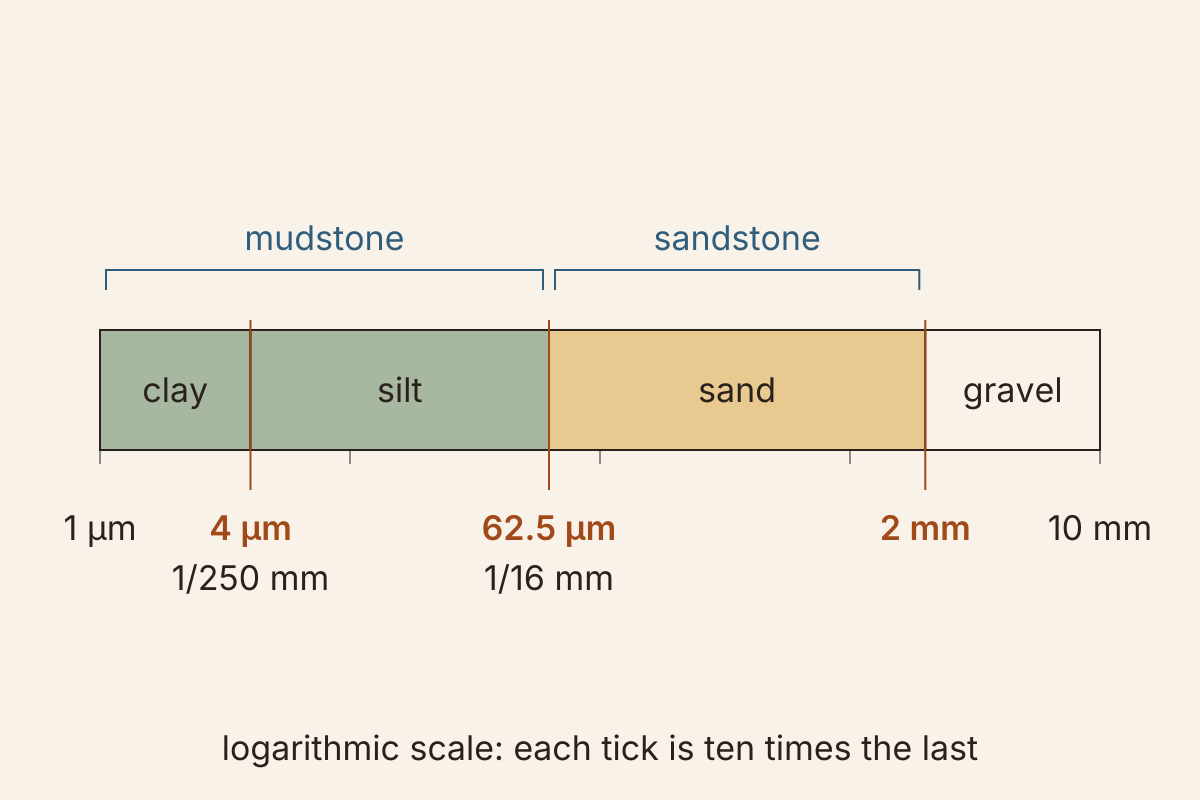
Sediment grain classes on a logarithmic bar, with mudstone over clay and silt and sandstone over sand.
Evidence Class bounds from USGS Open-File Report 2006-1195 (Wentworth grade scale); the fractions of a millimeter are calculated from those bounds.
"Grain-size classes of sediment on a logarithmic scale" by Strata & Seafloor, https://strataandseafloor.com/rocks-minerals/rock-identification/, licensed under CC BY 4.0 (https://creativecommons.org/licenses/by/4.0/)
Data: USGS Open-File Report 2006-1195, Nomenclature, Wentworth grade scale (U.S. Government work), retrieved 2026-11-18; USGS Educational Resources, What's New? Weeks 9-12 (U.S. Government work), retrieved 2026-11-18
Color can shift as a rock cools, or later. A USGS guide says Mount Rainier’s lava rocks mostly share one magma source and that “cooling conditions determine much of the appearance of igneous rocks.” Steam rusted the iron in some to red or mauve, and hot acidic water stained others yellow and orange. Rocks in national parks are protected; taking them is prohibited.
How do hardness and streak tests work?
Hardness and streak tests name minerals, not rocks. The USGS calls minerals the building blocks of rocks; granite, for example, contains quartz, feldspar, muscovite, hornblende and other minerals.
Streak is “the color of the residue left by scratching a mineral on a tile of unglazed porcelain,” in the NPS definition. It can differ from a mineral’s surface color: the hematite below shows dark, glittering crystals, yet its streak is reddish brown.
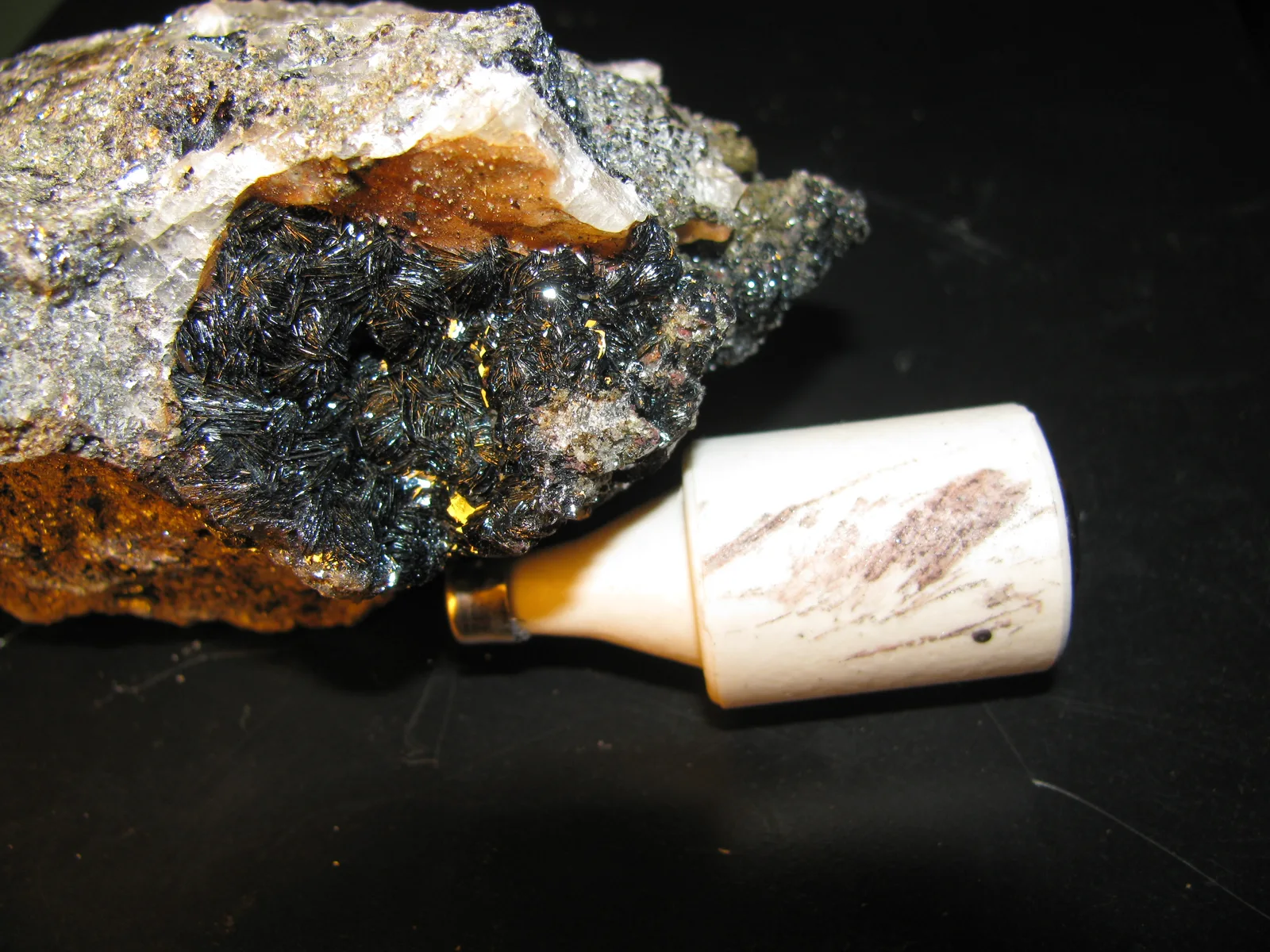
Hematite next to the reddish-brown streak it left on a white ceramic piece.
"Hematite with streak" by Kittil hagen — https://commons.wikimedia.org/wiki/File:Hematite_with_streak.JPG — Public Domain (US and EU: released into the public domain worldwide by the photographer and copyright holder, Kittil hagen, on the Commons file page, with a grant of use for any purpose where release is not legally possible)
Hardness is a mineral’s resistance to scratching, ranked on the Mohs hardness scale. The NPS lists common objects for comparison: a fingernail at 2.5, a copper penny at 3.5, and a knife or glass plate at 5.5. The glass plate is laid flat on a table, never held in the hand, and broken glass is not used.
In an NPS classroom activity, limestone bubbles under drops of white vinegar as it dissolves and gives off carbon dioxide. Eye protection is worn for this test, and hydrochloric acid is not used. Specimens are not licked, tasted, crushed or ground.
Streak turns up on the USGS meteorite checklist too. The agency does not verify meteorites. It does list traits: usually heavy for their size, often magnetic, no bubbles, and no streak on unglazed ceramic. A dense rock that leaves a black or red streak probably contains magnetite or hematite.
The three rock types the key sorts into are traced in the rock cycle. Schist, granite and sandstone share one canyon wall in Grand Canyon rock layers; rocks in national parks are protected, and taking them is prohibited.
Sources
- U.S. Geological Survey Educational Resources, "What's New? Weeks 9-12" (Week 12: Rocks and Minerals). www.usgs.gov/educational-resources/whats-new-w…Read: full textText license: U.S. Government work (17 U.S.C. §105) (terms)
- U.S. Geological Survey, "Rock Stars", in Living with a Volcano in Your Backyard: An Educator's Guide with Emphasis on Mount Rainier, General Information Product 19 (prepared in collaboration with the National Park Service; activity last modified November 21, 2014). pubs.usgs.gov/gip/19/downloads/Chapter_2/Activi…Read: full textText license: U.S. Government work (17 U.S.C. §105) (terms)
- James St. John, "Granite or granodiorite (Sierra Nevada Batholith, Early Cretaceous)", file description on Wikimedia Commons, 2016, CC BY 2.0. commons.wikimedia.org/wiki/File:Granite_or_granodiorite…Read: file page (description and license)Text license: CC BY 2.0 (terms)
- U.S. Geological Survey, "Can you identify my rock or mineral?" (FAQ). www.usgs.gov/faqs/can-you-identify-my-rock-or-…Read: full textText license: U.S. Government work (17 U.S.C. §105) (terms)
- National Park Service, "Metamorphic Rocks" (Geology). www.nps.gov/subjects/geology/metamorphic.htmRead: full textText license: U.S. Government work. No protection is claimed in original U.S. Government works (terms)
- U.S. Geological Survey, "Nomenclature", in Surficial sediment character of the Louisiana offshore continental shelf region: A GIS Compilation, Open-File Report 2006-1195. pubs.usgs.gov/of/2006/1195/htmldocs/nomenclatur…Read: full textText license: U.S. Government work (17 U.S.C. §105) (terms)
- National Park Service, "Minerals" (Geology). www.nps.gov/subjects/geology/minerals.htmRead: full textText license: U.S. Government work. No protection is claimed in original U.S. Government works (terms)
- National Park Service, "Mohs Hardness Scale" (article, last updated April 12, 2023). www.nps.gov/articles/mohs-hardness-scale.htmRead: full textText license: U.S. Government work. No protection is claimed in original U.S. Government works (terms)
- National Park Service, Wind Cave National Park, "Make a Cave" (education activity). www.nps.gov/wica/learn/education/make-a-cave.…Read: full textText license: U.S. Government work. No protection is claimed in original U.S. Government works (terms)
- U.S. Geological Survey, "I think I found a meteorite. How can I tell for sure?" (FAQ). www.usgs.gov/faqs/i-think-i-found-a-meteorite-…Read: full textText license: U.S. Government work (17 U.S.C. §105) (terms)

Cite this page
Strata & Seafloor. “Rock Identification: Look at Grain Size Before Color.” First published November 18, 2026. https://strataandseafloor.com/rocks-minerals/rock-identification/. Accessed on the day you read it.
How ages and sources are checkedAll correctionsReport an error on this page (contact@strataandseafloor.com)
Also in Rocks & Minerals
RM Comparison and scale list
Rock Cycle: Any Rock Type Can Become Any Other
Filed
Picture credit
"Black Hand Sandstone (Lower Mississippian; Rock House, Hocking Hills, Ohio, USA) 2" by James St. John — https://commons.wikimedia.org/wiki/File:Black_Hand_Sandstone_(Lower_Mississippian;_Rock_House,_Hocking_Hills,_Ohio,_USA)_2.jpg — CC BY 2.0 (https://creativecommons.org/licenses/by/2.0/)
RM Comparison and scale list
Mohs Hardness Scale: The Steps Are Ranks, Not Equal Units
Filed
Picture credit
"Portrait of Friedrich Mohs, lithograph, 1832" by Kriehuber (artist); Gebr. Mansfeld & Comp. (printer) — https://commons.wikimedia.org/wiki/File:Friedrich_Mohs_portrait_by_Kriehuber_1832.jpg — Public Domain (US: published 1832, before January 1, 1931; EU: artist Kriehuber d. 1876 (Commons marks the file PD-old-100 and Public Domain Mark 1.0); faithful reproduction of a two-dimensional work)
RM Field entry
Geodes: Formed in Hollows, Then Lined From the Outside In
Filed
Picture credit
"Quartz-barite-calcite geode" by James St. John — https://commons.wikimedia.org/wiki/File:Quartz-barite-calcite_geode_(Rt._37_roadcut,_Harrodsburg,_Indiana,_USA)_(33656807910).jpg — CC BY 2.0 (https://creativecommons.org/licenses/by/2.0/); modified: cropped