Comparison and scale list
Mohs Hardness Scale: The Steps Are Ranks, Not Equal Units
Strata & Seafloor Filed
The short answer
The Mohs hardness scale ranks ten minerals by how well they resist scratching, from talc at 1 to diamond at 10: talc, gypsum, calcite, fluorite, apatite, orthoclase, quartz, topaz, corundum and diamond, in the order the NPS and the USGS give. The numbers are ranks, not measurements. A 1957 USGS bulletin says they show only increasing hardness, not actual values.
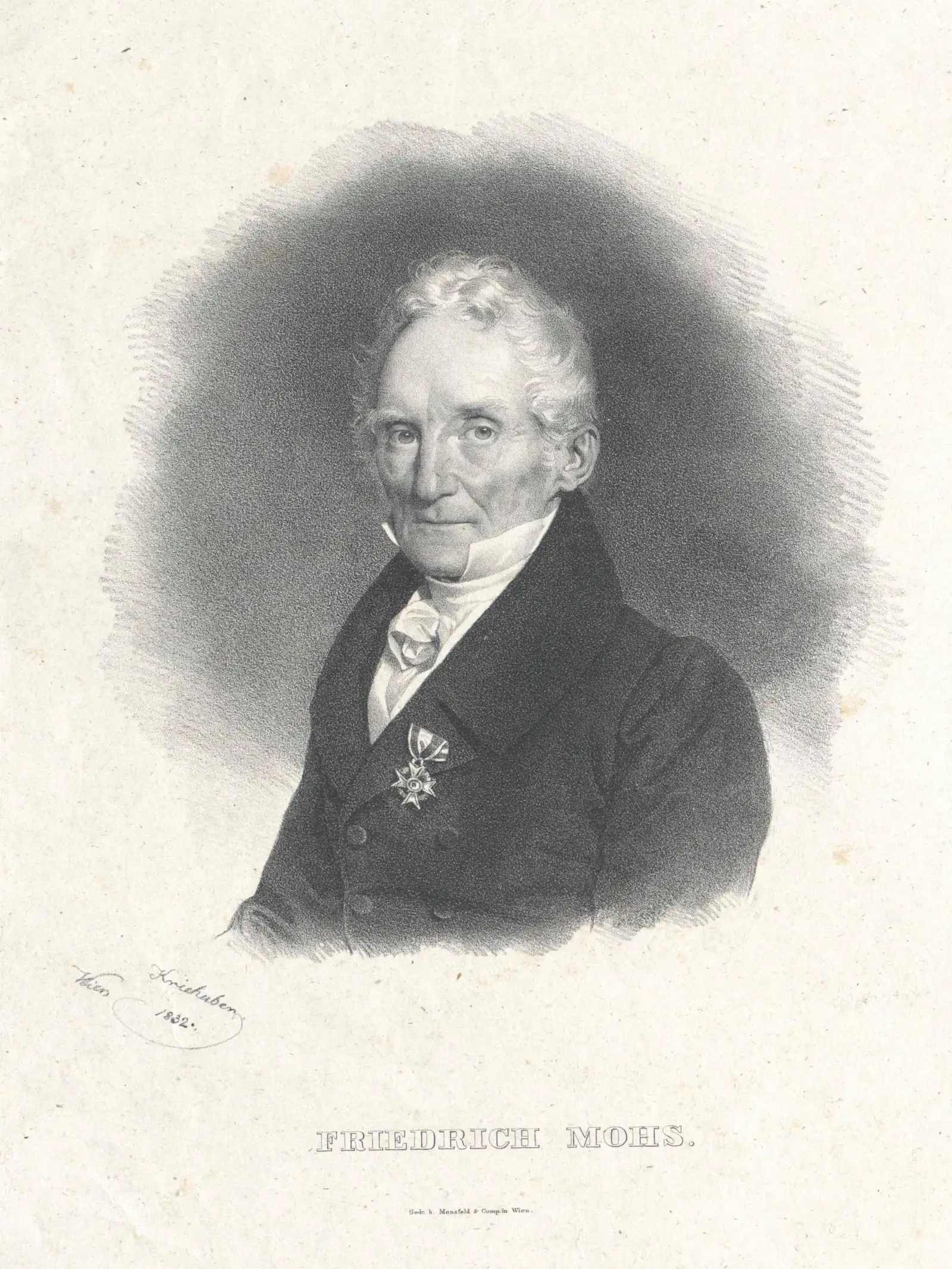
Friedrich Mohs, the mineralogist the scale is named for, in a lithograph portrait signed by Kriehuber in Vienna in 1832.
"Portrait of Friedrich Mohs, lithograph, 1832" by Kriehuber (artist); Gebr. Mansfeld & Comp. (printer) — https://commons.wikimedia.org/wiki/File:Friedrich_Mohs_portrait_by_Kriehuber_1832.jpg — Public Domain (US: published 1832, before January 1, 1931; EU: artist Kriehuber d. 1876 (Commons marks the file PD-old-100 and Public Domain Mark 1.0); faithful reproduction of a two-dimensional work)
A fingernail scratches gypsum but not calcite, and that pair sits at the heart of the Mohs scale. The NPS hardness chart puts a fingernail at 2.5, between gypsum at 2 and calcite at 3. Each mineral on the scale is a reference point: as a rule, whatever it scratches ranks lower and whatever scratches it ranks higher.
The NPS defines a mineral’s hardness as “a measure of its relative resistance to scratching” and names the scale for “the German geologist and mineralogist Friedrich Mohs.” A USGS gemstone page calls him “an Austrian mineralogist” instead and says that he developed the scale in 1822. The idea is older than the name: according to the NPS, comparing hardness goes back as far as 300 BC, to Theophrastus and his treatise On Stones.
The ten minerals, in order
The NPS chart and USGS Bulletin 1042-G, Gem Stones of the United States (1957), list the same ten minerals in the same order. Talc sits at the bottom. The NPS calls it “the softest known mineral,” one that “can be scratched with a fingernail.” Diamond holds the top rank, 10, and the USGS bulletin puts “extreme hardness” first among its unusual qualities.
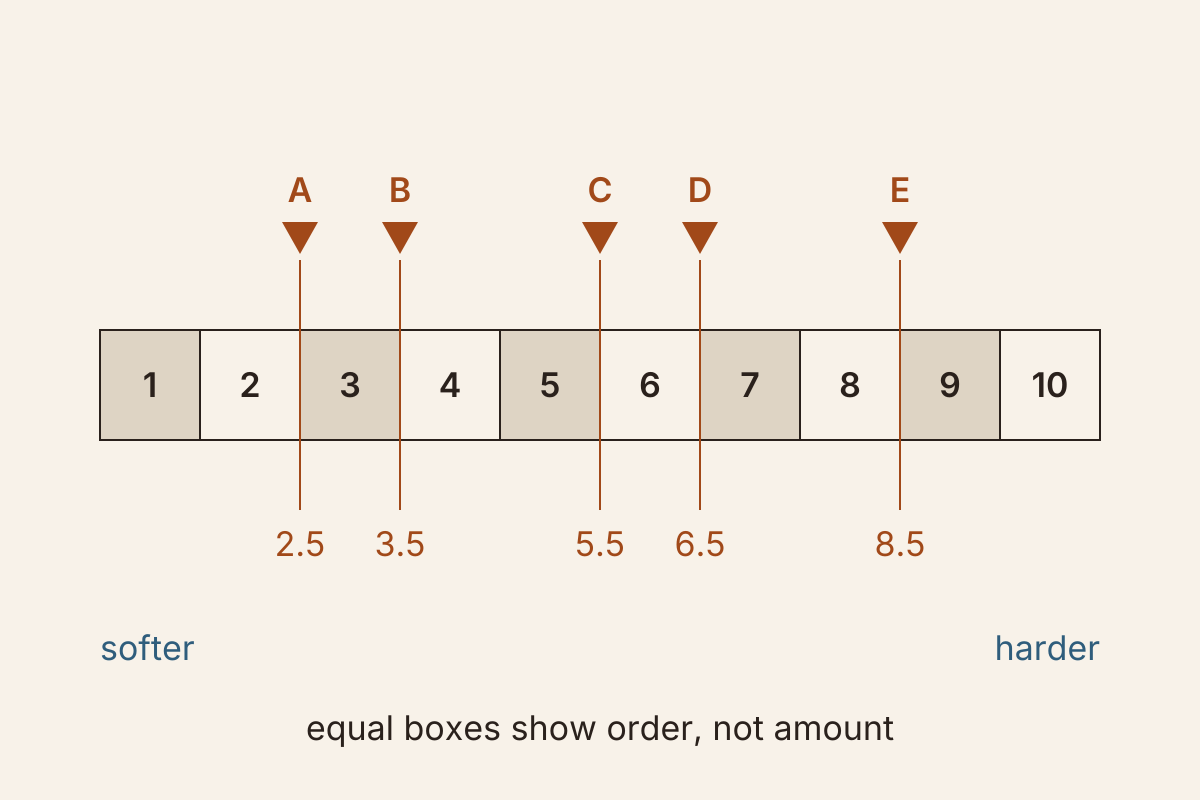
The ten Mohs ranks as equal boxes, with five everyday objects from the NPS chart placed between them.
Evidence Ranks and object numbers from the NPS Mohs Hardness Scale chart; the order of the ten minerals agrees with USGS Bulletin 1042-G (1957).
Key to the letters and numbers
- 1 talc
- 2 gypsum
- 3 calcite
- 4 fluorite
- 5 apatite
- 6 orthoclase
- 7 quartz
- 8 topaz
- 9 corundum
- 10 diamond
- A fingernail, 2.5
- B copper penny, 3.5
- C knife or glass plate, 5.5
- D steel nail, 6.5
- E masonry drill bit, 8.5
"The ten Mohs ranks with five everyday objects placed between them" by Strata & Seafloor, https://strataandseafloor.com/rocks-minerals/mohs-hardness-scale/, licensed under CC BY 4.0 (https://creativecommons.org/licenses/by/4.0/)
Data: National Park Service, Mohs Hardness Scale (U.S. Government work; No protection is claimed in original U.S. Government works), retrieved 2026-11-18; USGS Bulletin 1042-G, Gem Stones of the United States, 1957 (U.S. Government work), retrieved 2026-11-18
| Rank | Mineral | Formula | Next to the NPS everyday objects |
|---|---|---|---|
| 1 | talc | Mg3Si4O10(OH)2 | below fingernail (2.5) |
| 2 | gypsum | CaSO4·2H2O | below fingernail (2.5) |
| 3 | calcite | CaCO3 | between fingernail (2.5) and copper penny (3.5) |
| 4 | fluorite | CaF2 | between copper penny (3.5) and knife or glass plate (5.5) |
| 5 | apatite | Ca5(PO4)3F | between copper penny (3.5) and knife or glass plate (5.5) |
| 6 | orthoclase | KAlSi3O8 | between knife or glass plate (5.5) and steel nail (6.5) |
| 7 | quartz | SiO2 | between steel nail (6.5) and masonry drill bit (8.5) |
| 8 | topaz | [Al(F,OH)2]AlSiO4 | between steel nail (6.5) and masonry drill bit (8.5) |
| 9 | corundum | Al2O3 | above masonry drill bit (8.5) |
| 10 | diamond | C | above masonry drill bit (8.5) |
Download the Mohs scale table (CSV) (sources and license of this file) Data: National Park Service, Mohs Hardness Scale and Minerals (U.S. Government works; No protection is claimed in original U.S. Government works), retrieved 2026-11-18; USGS Bulletin 1042-G (1957); USGS Natural Gemstones; USGS SIR 2017-5118; USGS Open-File Report 03-395 (U.S. Government works), retrieved 2026-11-18
The formulas come from USGS and NPS pages. Apatite is a mineral group, so the formula shown is fluorapatite, taken from a USGS sample record, and the topaz formula is written as the 1957 bulletin gives it. A USGS gemstone page lists feldspar at 6, where the NPS chart names orthoclase, and sapphire, a variety of corundum, at 9.
Ranks, not measurements
The 1957 USGS bulletin is plain about the numbers: “The numbers preceding each mineral indicate only increasing degrees of hardness, not actual values.” Its example is the top step, where “the diamond, rated as 10, is many times harder than corundum, rated as 9.” Corundum holds rank 9 only because, in the bulletin’s words, it is “the mineral nearest the diamond in hardness.”
Because the scale says which of two minerals is harder and nothing about the size of the difference, the step from 9 to 10 need not be the same size as the step from 1 to 2. None of the USGS or NPS pages cited here gives a measured hardness for the ten minerals, so the grid below shows order only.
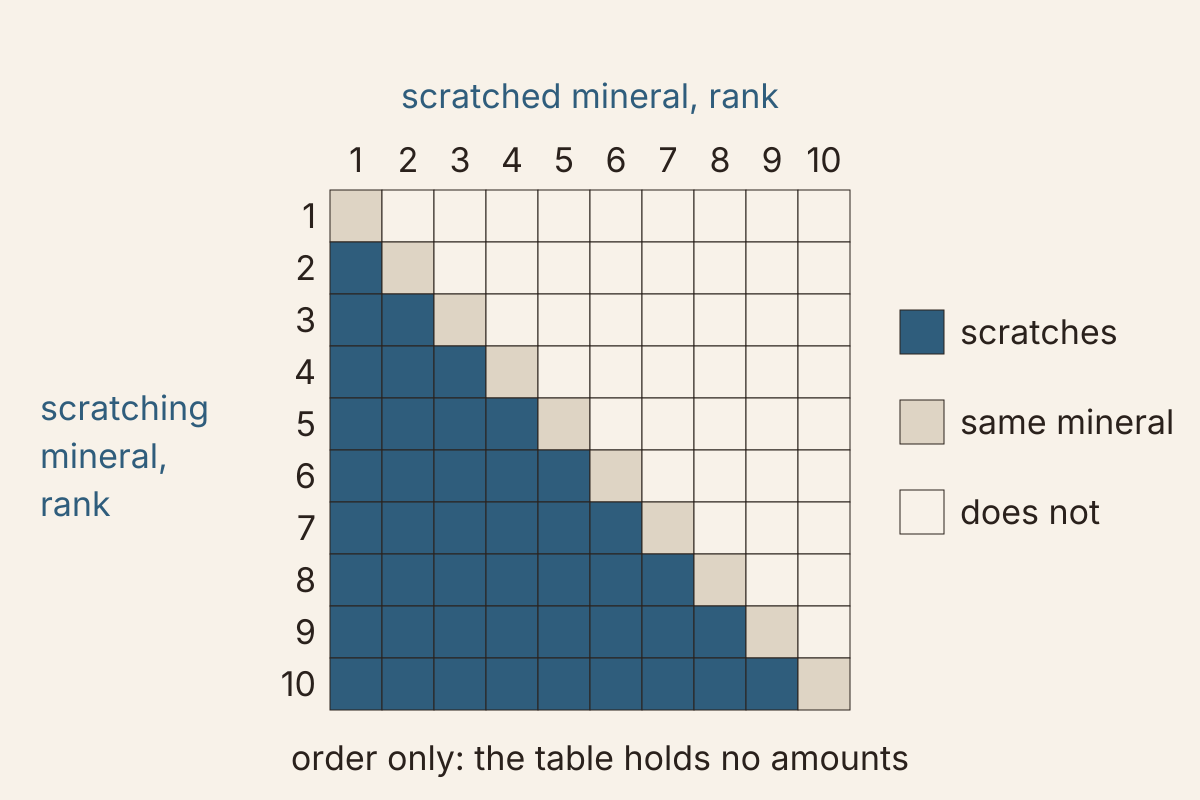
Which mineral scratches which on the Mohs scale: a filled cell means the row’s mineral scratches the column’s, and the grid holds order only.
Evidence Ranks from the NPS chart and USGS Bulletin 1042-G; each filled cell follows from the ranks, 45 of the 100 cells.
Key to the letters and numbers
- 1 talc
- 2 gypsum
- 3 calcite
- 4 fluorite
- 5 apatite
- 6 orthoclase
- 7 quartz
- 8 topaz
- 9 corundum
- 10 diamond
"Which Mohs mineral scratches which: a table of order only" by Strata & Seafloor, https://strataandseafloor.com/rocks-minerals/mohs-hardness-scale/, licensed under CC BY 4.0 (https://creativecommons.org/licenses/by/4.0/)
Data: National Park Service, Mohs Hardness Scale (U.S. Government work; No protection is claimed in original U.S. Government works), retrieved 2026-11-18; USGS Bulletin 1042-G, Gem Stones of the United States, 1957 (U.S. Government work), retrieved 2026-11-18
A single rank can also hide a spread inside one mineral. The same bulletin warns that “some minerals are harder in one direction than another,” so a single crystal can resist scratching better in one direction than in another. In case-file terms, a Mohs number records which mineral won a scratch contest, not the size of the margin.
Everyday scratch tests
The NPS chart lists five common objects with hardness numbers: a fingernail at 2.5, a copper penny at 3.5, a knife or glass plate at 5.5, a steel nail at 6.5 and a masonry drill bit at 8.5. Every one of them falls between two ranks, so a test against them places a mineral in a bracket, such as harder than a penny but softer than glass, rather than on a single number.
What can scratch glass? On the NPS chart, a glass plate sits at 5.5. Orthoclase at 6 and every mineral above it rank harder than glass, while apatite at 5 and every mineral below it rank softer. The NPS minerals page gives potassium feldspar a hardness of 6 and says that calcite is “easily scratched with a knife.”
The same NPS page shows why a bracket is often enough. Fluorite “is often mistaken for quartz,” it says, “but it has a lower hardness of 4,” while quartz ranks 7, and a glass plate at 5.5 sits between the two. Mica, at 2.5 in the NPS account, is soft enough to be scratched with a fingernail.
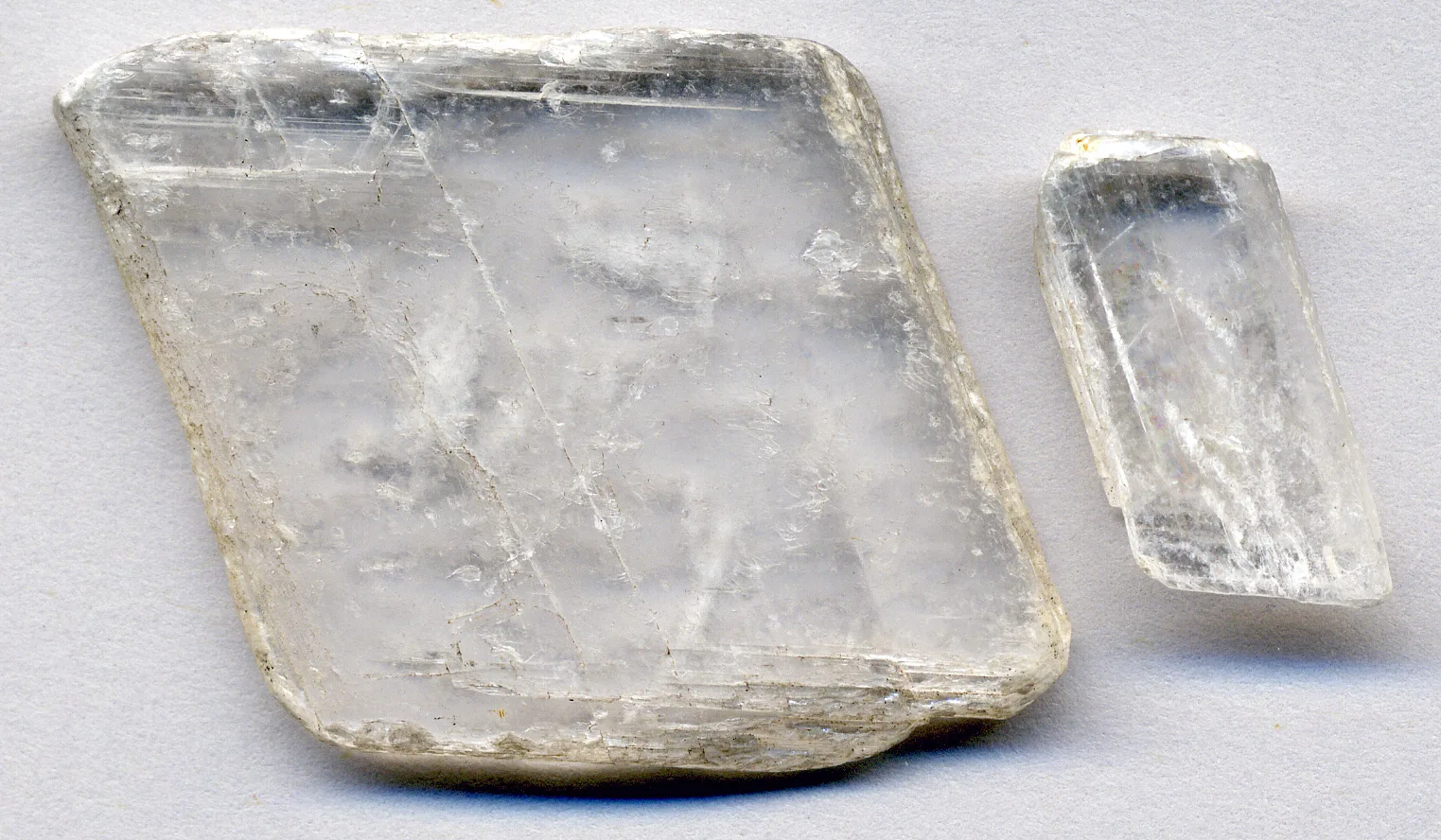
Gypsum, rank 2, as thin clear plates; the larger piece is 2.7 cm across along its top edge.
"Gypsum" by James St. John — https://commons.wikimedia.org/wiki/File:Gypsum_(31863387400).jpg — CC BY 2.0 (https://creativecommons.org/licenses/by/2.0/)
The shape of those pieces has its own cause. The photographer’s file description notes that gypsum has one well-developed cleavage plane, so broken specimens “are frequently thin plates.”
In a scratch test, the glass plate is laid flat on a table, never held in the hand, and broken glass is not used. Specimens are not crushed or ground, and the USGS bulletin adds that scratching a stone to test it “may mutilate” the stone. This page does not appraise, authenticate or price specimens.
Two other entries pick up minerals from this table. Quartz, rank 7, turns up again in geodes, and the volcanic glass in obsidian is compared with true minerals there.
Hard is not tough
Is diamond unbreakable? Hardness on this scale means resistance to scratching, not resistance to breaking. The USGS bulletin lists the cleavage of diamond as perfect and notes that “diamonds may be cleaved in four directions parallel to the faces of an octahedron.” Cleavage, in the same bulletin, is the tendency of certain gem stones, “when struck in the proper place, to split in one direction more readily than in another.”
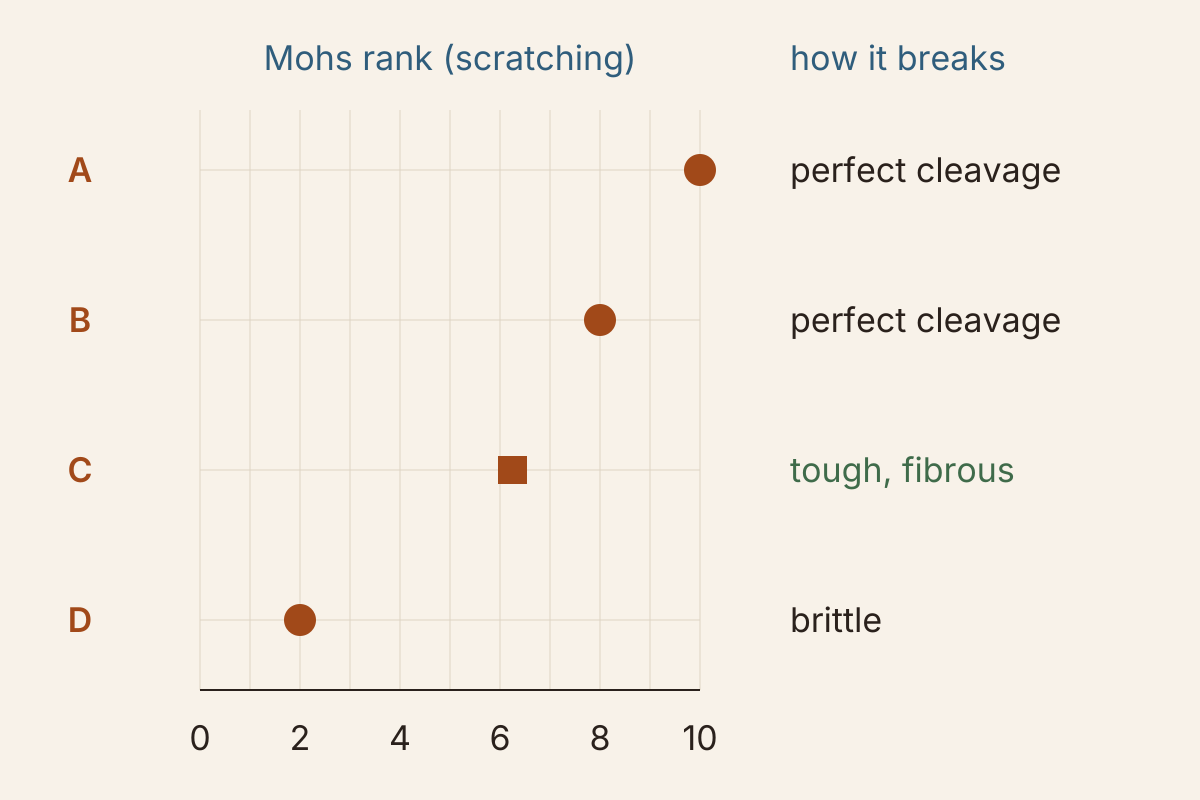
Mohs rank set against how four minerals break: the two highest ranks have perfect cleavage, while a mineral near 6 is tough.
Evidence Hardness and breakage from USGS Bulletin 1042-G (diamond, topaz, nephrite) and the photographer’s Commons description of gypsum (CC BY 2.0).
Key to the letters and numbers
- A diamond
- B topaz
- C nephrite (jade)
- D gypsum
"Four minerals: Mohs rank set against how they break" by Strata & Seafloor, https://strataandseafloor.com/rocks-minerals/mohs-hardness-scale/, licensed under CC BY 4.0 (https://creativecommons.org/licenses/by/4.0/)
Data: USGS Bulletin 1042-G, Gem Stones of the United States, 1957 (U.S. Government work), retrieved 2026-11-18; James St. John, Commons file description of Gypsum (31863387400), CC BY 2.0, https://commons.wikimedia.org/wiki/File:Gypsum_(31863387400).jpg
| Mineral | Mohs hardness | How it breaks | Source |
|---|---|---|---|
| diamond | 10 | perfect cleavage, in four directions | USGS 1957 |
| topaz | 8 | perfect cleavage, parallel to the base | USGS 1957 |
| nephrite (jade) | 6.0 to 6.5 | tough and fibrous | USGS 1957 |
| gypsum | 2 | rather fragile or brittle, one good cleavage | James St. John, Commons |
Jade runs the other way. The bulletin calls jadeite and nephrite “tough, and fibrous” and traces that toughness to “a complex interweaving of minute fibrous crystals,” even though nephrite ranks only 6.0 to 6.5. The same bulletin ties the durability of a stone to its “hardness and lack of ready cleavage,” two separate properties, and a Mohs number covers only the first.
The page on rock identification lays out where the scratch test fits among the other clues, starting with grain size. Quartz, rank 7, also appears at Meteor Crater, where a study reported by the USGS identified coesite, a high-pressure form of SiO2, in sheared sandstone.
Sources
- National Park Service, "Mohs Hardness Scale" (article, last updated April 12, 2023). www.nps.gov/articles/mohs-hardness-scale.htmRead: full textText license: U.S. Government work. No protection is claimed in original U.S. Government works (terms)
- Dorothy M. Schlegel, "Gem Stones of the United States", U.S. Geological Survey Bulletin 1042-G (Contributions to Economic Geology), 1957. pubs.usgs.gov/bul/1042g/report.pdfRead: full textText license: U.S. Government work (17 U.S.C. §105) (terms)
- U.S. Geological Survey, "Mineral Gemstones", in Natural Gemstones (General Interest Publication; page last modified 1997). pubs.usgs.gov/gip/gemstones/mineral.htmlRead: full textText license: U.S. Government work (17 U.S.C. §105) (terms)
- National Park Service, "Minerals" (Geology). www.nps.gov/subjects/geology/minerals.htmRead: full textText license: U.S. Government work. No protection is claimed in original U.S. Government works (terms)
- U.S. Geological Survey, "Gypsum", in Geochemical and Mineralogical Maps, with Interpretation, for Soils of the Conterminous United States, Scientific Investigations Report 2017-5118. pubs.usgs.gov/sir/2017/5118/elements/Gypsum/Gps…Read: full textText license: U.S. Government work (17 U.S.C. §105) (terms)
- Roger N. Clark and others, "Fluorapatite WS416" sample description, USGS Digital Spectral Library splib05a, U.S. Geological Survey Open-File Report 03-395, 2003. pubs.usgs.gov/of/2003/ofr-03-395/DESCRIPT/M/flu…Read: full textText license: U.S. Government work (17 U.S.C. §105) (terms)
- Roger N. Clark and others, "Orthoclase HS13" sample description, USGS Digital Spectral Library splib05a, U.S. Geological Survey Open-File Report 03-395, 2003. pubs.usgs.gov/of/2003/ofr-03-395/DESCRIPT/M/ort…Read: full textText license: U.S. Government work (17 U.S.C. §105) (terms)
- James St. John, "Gypsum" (31863387400), file description on Wikimedia Commons, 2017, CC BY 2.0. commons.wikimedia.org/wiki/File:Gypsum_(31863387400).jpgRead: file page (description and license)Text license: CC BY 2.0 (terms)
- Chao, E. C. T., Shoemaker, E. M., and Madsen, B. M., 1960, First natural occurrence of coesite: Science, v. 132, no. 3421, p. 220-222, doi:10.1126/science.132.3421.220 (USGS Publications Warehouse record). www.usgs.gov/publications/first-natural-occurr…Read: record page onlyText license: USGS publication record page: U.S. Government work (17 U.S.C. §105); the Science (1960) article it describes is cited for facts, not reproduced (terms)

Cite this page
Strata & Seafloor. “Mohs Hardness Scale: The Steps Are Ranks, Not Equal Units.” First published November 18, 2026. https://strataandseafloor.com/rocks-minerals/mohs-hardness-scale/. Accessed on the day you read it.
How ages and sources are checkedAll correctionsReport an error on this page (contact@strataandseafloor.com)
Also in Rocks & Minerals
RM Interactive or diagram page
Rock Identification: Look at Grain Size Before Color
Filed
Picture credit
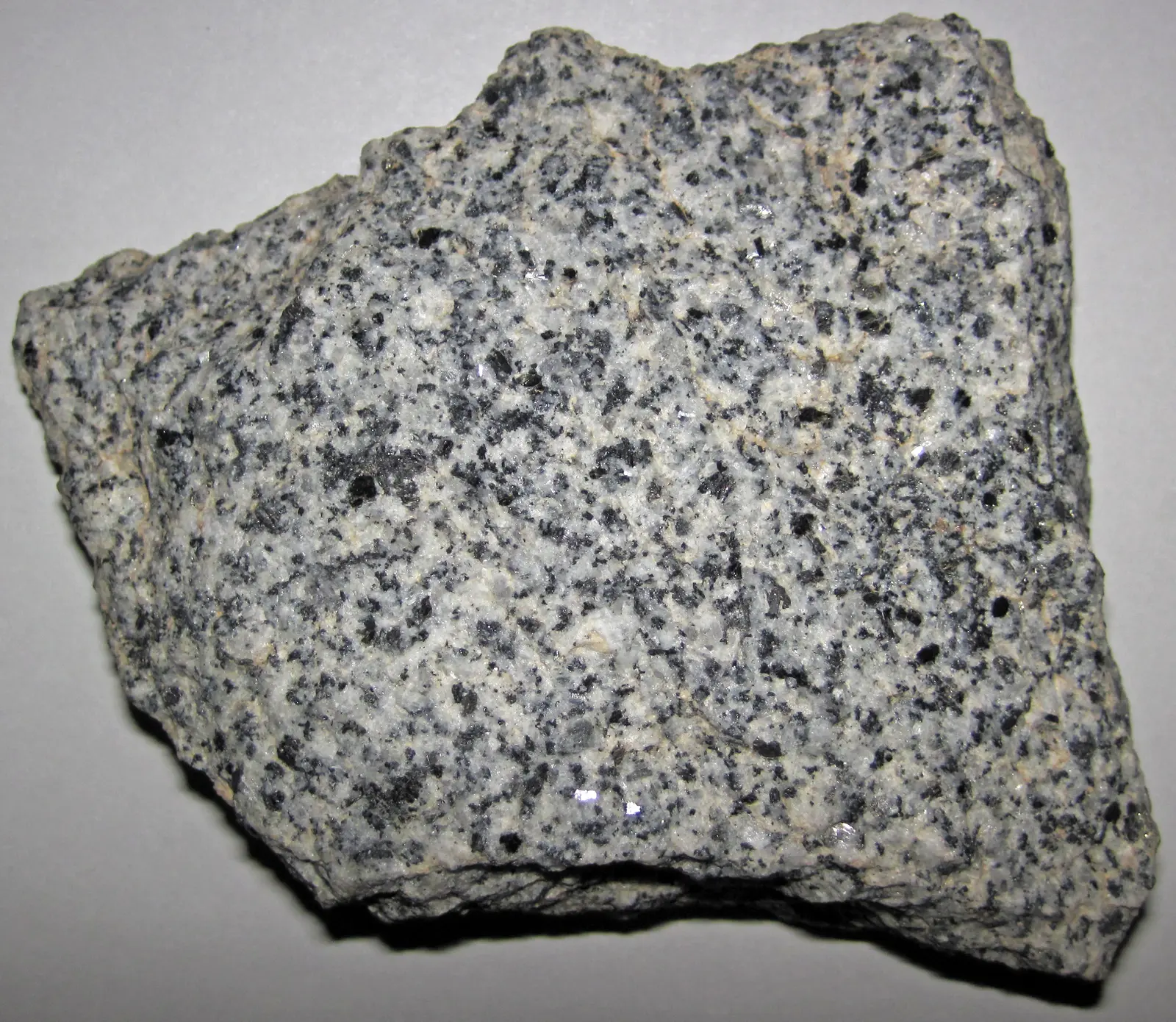
"Granite or granodiorite (Sierra Nevada Batholith, Early Cretaceous)" by James St. John — https://commons.wikimedia.org/wiki/File:Granite_or_granodiorite_(Sierra_Nevada_Batholith,_Early_Cretaceous;_Lower_Rock_Creek_Road,_near_Bishop,_California,_USA)_(30715327533).jpg — CC BY 2.0 (https://creativecommons.org/licenses/by/2.0/)
RM Comparison and scale list
Rock Cycle: Any Rock Type Can Become Any Other
Filed
Picture credit
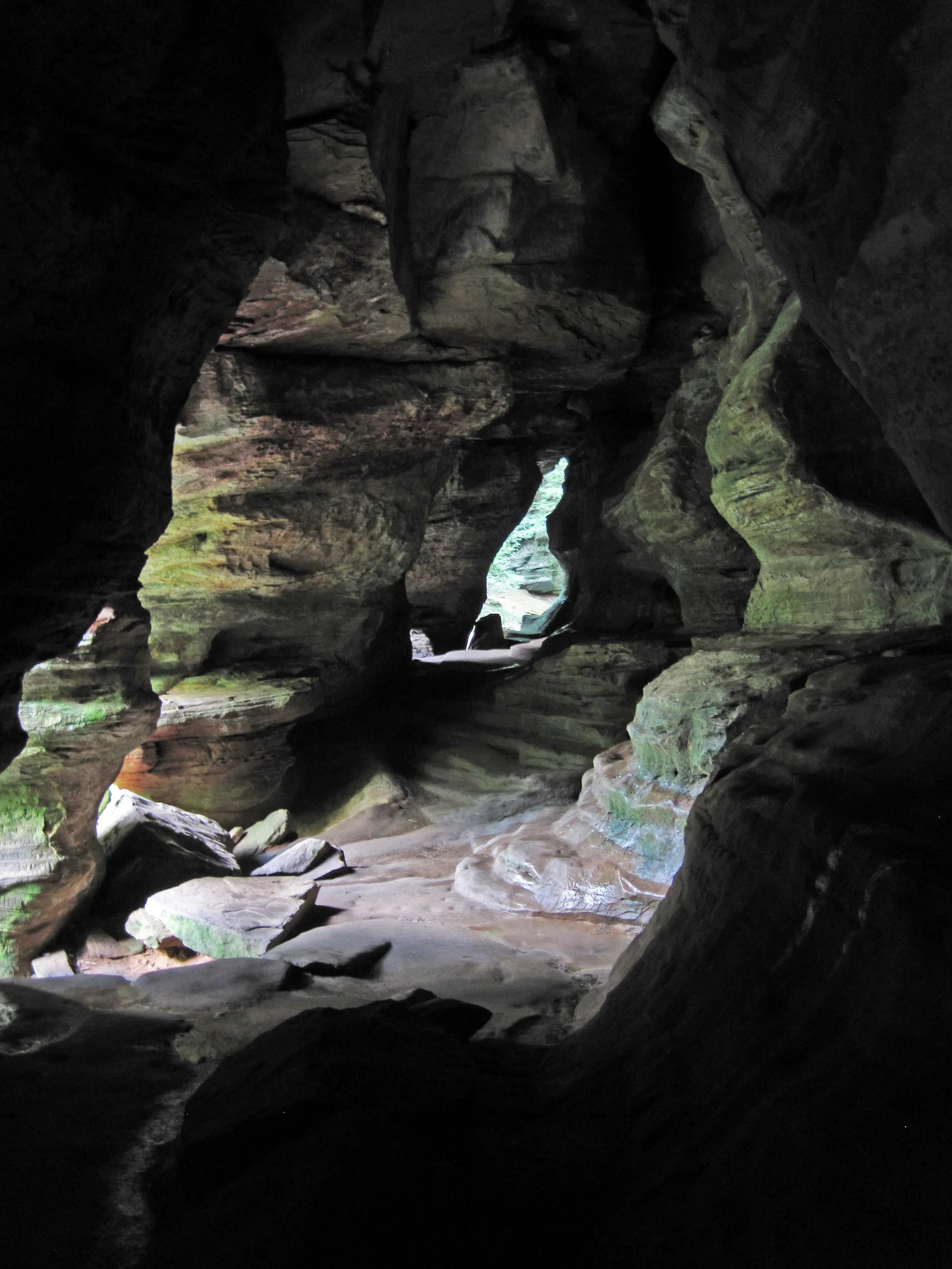
"Black Hand Sandstone (Lower Mississippian; Rock House, Hocking Hills, Ohio, USA) 2" by James St. John — https://commons.wikimedia.org/wiki/File:Black_Hand_Sandstone_(Lower_Mississippian;_Rock_House,_Hocking_Hills,_Ohio,_USA)_2.jpg — CC BY 2.0 (https://creativecommons.org/licenses/by/2.0/)
RM Field entry
Geodes: Formed in Hollows, Then Lined From the Outside In
Filed
Picture credit
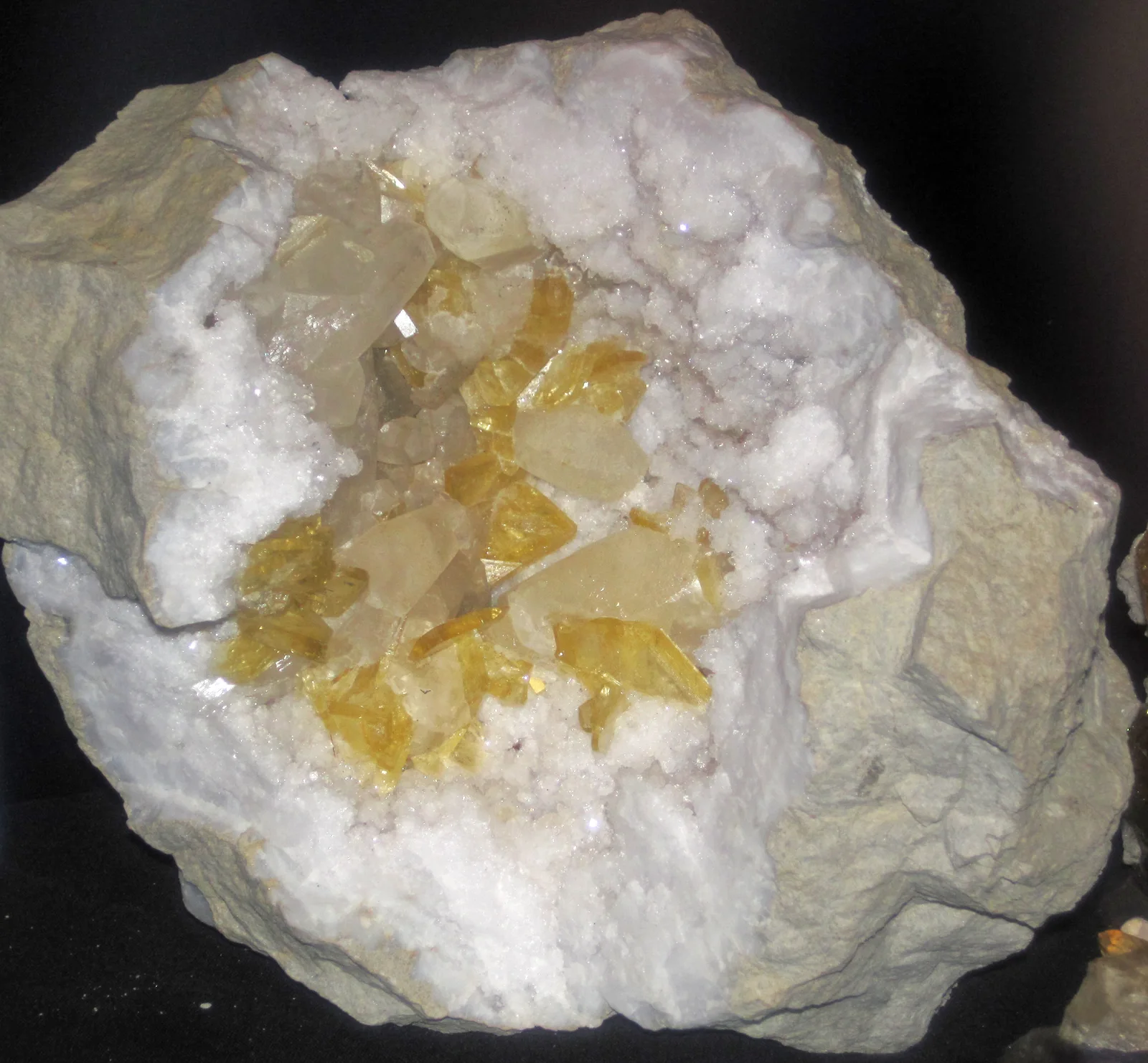
"Quartz-barite-calcite geode" by James St. John — https://commons.wikimedia.org/wiki/File:Quartz-barite-calcite_geode_(Rt._37_roadcut,_Harrodsburg,_Indiana,_USA)_(33656807910).jpg — CC BY 2.0 (https://creativecommons.org/licenses/by/2.0/); modified: cropped