Reading the evidence
Hydrothermal Vents: Found Where Geologists Expected Heat
Strata & Seafloor Filed
The short answer
NOAA Ocean Exploration describes hydrothermal vents as seafloor openings where seawater, heated by magma beneath the seafloor, flows back out hot and loaded with dissolved minerals. It says the first were sighted in 1977 near the Galápagos Islands, at a depth of 2,500 meters; a 2024 paper adds that geologists had predicted them from heat missing at the mid-ocean ridges.
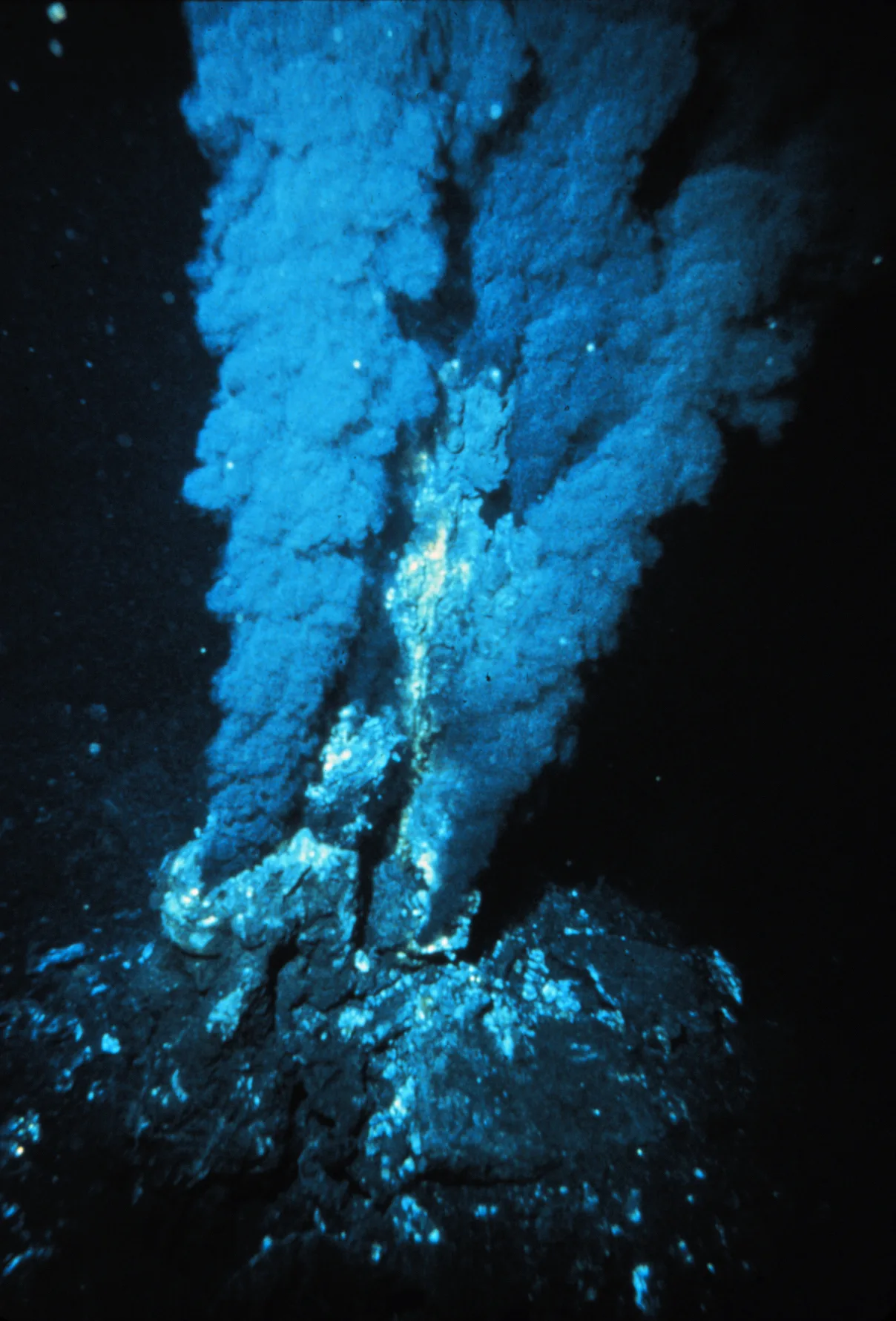
A black smoker at a hydrothermal vent on a mid-ocean ridge in the Atlantic Ocean, with plumes of mineral-laden water rising from its chimney.
“Black smoker at a mid-ocean ridge hydrothermal vent, Atlantic Ocean”, P. Rona / OAR/National Undersea Research Program (NURP); NOAA; public domain.
Full credit
"Black smoker at a mid-ocean ridge hydrothermal vent, Atlantic Ocean" by P. Rona / OAR/National Undersea Research Program (NURP); NOAA — https://commons.wikimedia.org/wiki/File:Blacksmoker_in_Atlantic_Ocean.jpg — Public Domain (US: U.S. Government work (17 U.S.C. §105), NOAA photo by P. Rona, OAR/National Undersea Research Program, taken as part of an employee's official duties per the file page; EU: no statutory public-domain basis, agency public-domain marking; upstream not traced)
On the Galápagos Rift floor, the vents were the expected find, and the animals around them were not. The NOAA fact sheet on hydrothermal vents describes the 1977 sighting as “a phenomenon that had been predicted but never before confirmed.” The 2024 paper says nobody was prepared for what lived there: a crowded community of animals in the dark beside the warm water.
That split is the useful way to read the case file. The vents themselves belong to geology: heat, cracks, seawater and minerals. The life around them was the part that changed biology.
Why geologists expected vents
Geologists expected vents because heat was missing at the mid-ocean ridges. A mid-ocean ridge is a long undersea mountain chain where plates pull apart and new crust forms over rising magma. A 2024 paper by Chong Chen, John Jamieson and Verena Tunnicliffe, published open access under a CC BY 4.0 license, sums up what was known before the first dive.
In their words, “The discovery of hydrothermal vents themselves on the eastern Galápagos Rift in 1977 was not really a surprise, as geologists had predicted their presence from the missing heat measured near ridge axes (Sclater and Klitgord 1973) and warm buoyant plumes collected by a towed vehicle (Weiss et al. 1977).”
The passage names two clues. Both earlier studies are cited here as the 2024 paper gives them. The first was a shortfall: less heat was measured near the ridge axes than geologists expected. The second was direct: a towed instrument collected warm, rising water above the seafloor.
Scale schematic, not to scale
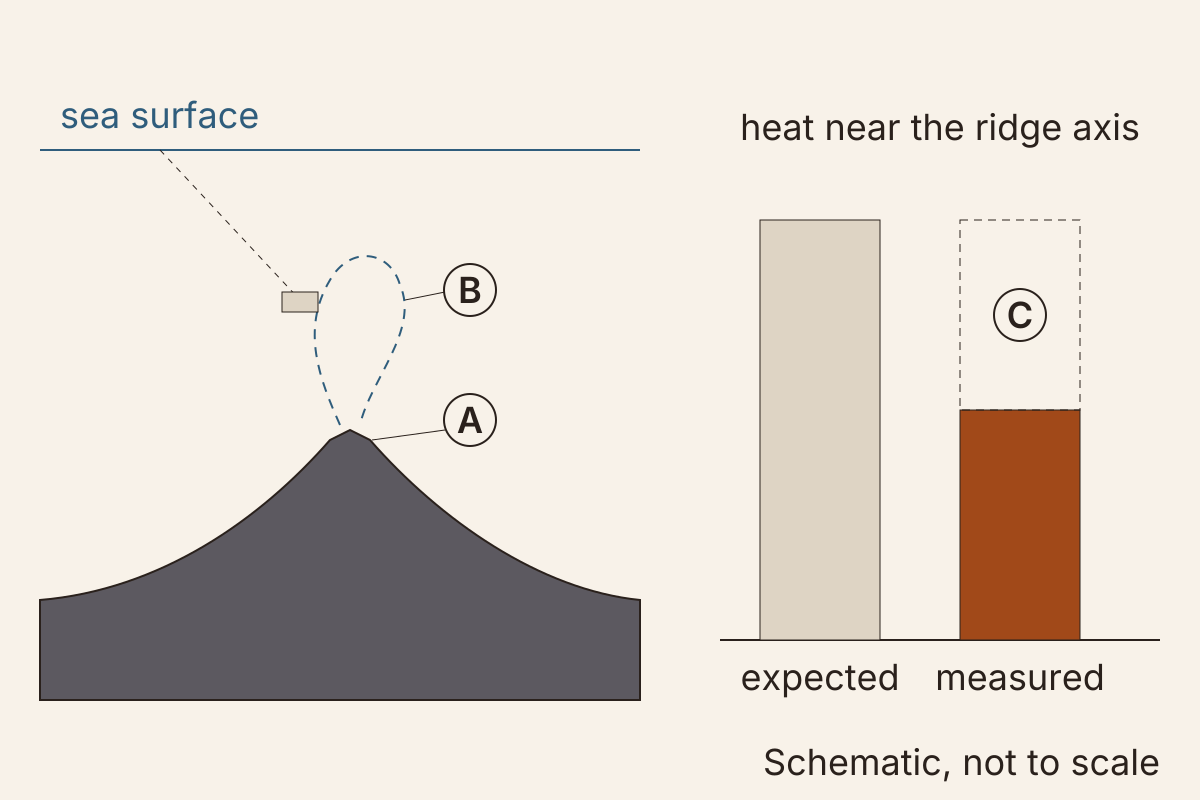
The two clues before the 1977 dive: heat missing near the ridge axis, and warm water rising in the ocean above it.
Evidence Drawn from the description in Chen, Jamieson and Tunnicliffe (2024); the bars are relative and carry no values.
Key to the letters and numbers
- A Ridge axis, where new crust forms over rising magma
- B Warm plume in the water above the ridge, sampled by a towed instrument
- C Missing heat: the gap between the heat expected near the ridge axis and the heat measured there
"Why geologists expected vents: missing heat at a ridge axis" by Strata & Seafloor, https://strataandseafloor.com/seafloor/hydrothermal-vents/, licensed under CC BY 4.0 (https://creativecommons.org/licenses/by/4.0/)
Data: Chen, Jamieson and Tunnicliffe 2024, Marine Biodiversity 54:16, PMC10869388 (CC BY 4.0), retrieved 2026-11-17
Read against the NOAA account of how vents work, the shortfall has a plain explanation. Water that sinks into the crust cold and comes back out hot carries heat away with it. A seafloor hot spring would move heat out of the ridge in its water, not through the rock. The warm plume was a sample of water like that.
How a vent works
A photo of a vent often shows a chimney first: a rough mineral tower with a cloud pouring from its top. The NOAA fact sheet explains the process behind it. Seawater percolates down through cracks in the ocean crust near spreading centers or subduction zones, and hot magma heats it.
On the way, the water trades chemicals with the hot rock. NOAA lists some that are removed from it, such as magnesium and sulfate ions, and many that are added, such as sulfur, copper, zinc, gold, iron and helium. The heated water then rises back to the seafloor.
Scale schematic, not to scale
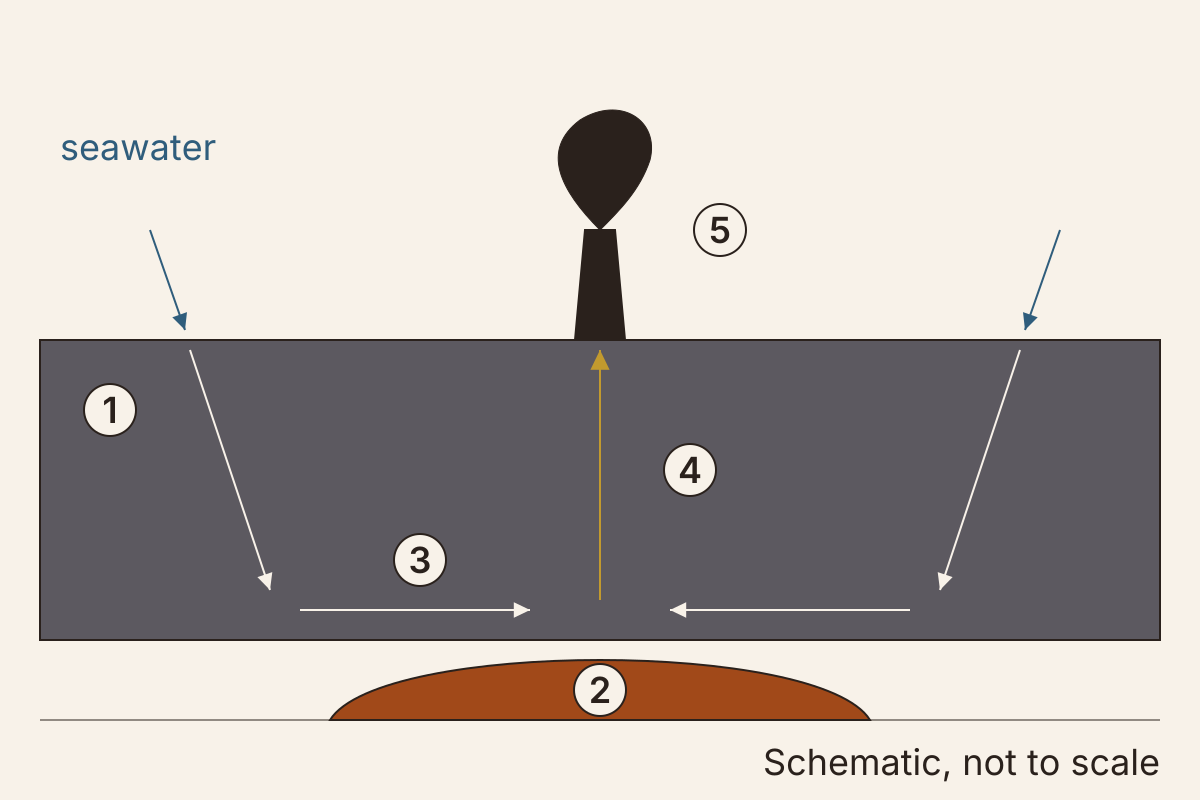
Seawater sinks into the crust, is heated by magma, picks up metals from the hot rock, and rises to the seafloor, where minerals settling out can build a chimney.
Evidence Steps and the temperature figure from the NOAA Ocean Exploration fact sheet cited below; no depths or distances are plotted.
Key to the letters and numbers
- 1 Cold seawater seeps down through cracks in the ocean crust
- 2 Magma beneath the seafloor heats the water
- 3 The heated water loses some chemicals, such as magnesium and sulfate, and gains others, such as sulfur, copper, zinc, gold, iron and helium
- 4 The hot water rises; it may reach higher than 400°C (750°F) without boiling
- 5 It meets near-freezing seawater, minerals settle out, and a chimney may grow
"How a hydrothermal vent works" by Strata & Seafloor, https://strataandseafloor.com/seafloor/hydrothermal-vents/, licensed under CC BY 4.0 (https://creativecommons.org/licenses/by/4.0/)
Data: NOAA Ocean Exploration, Hydrothermal Vents fact sheet (facts cited; text not reproduced), retrieved 2026-11-17
How hot is vent water?
The NOAA fact sheet says water rising out of vents may reach higher than 400°C (750°F). Water that hot would boil at sea level. On the deep seafloor, NOAA explains, the high pressure keeps it from boiling.
The next step is quick. As the hot, metal-rich fluid rises, it mixes with near-freezing seawater. NOAA says rapid chemical reactions then make sulfur and other minerals precipitate, or drop out of the water as solid grains. Those grains may build chimneys or towers and leave mineral-rich deposits on the seafloor around them.
Why are black smokers black?
Black smokers are black because of iron sulfide. In the words of the NOAA fact sheet, “‘Black smokers’ are chimneys formed from deposits of iron sulfide, which is black.” The same page describes white smokers as chimneys formed from deposits of barium, calcium and silicon, which are white.
The “smoke” is not smoke. A NOAA photo caption in the same fact sheet explains that the vent fluid looks like dark smoke because of the high levels of minerals and sulfides it carries. The cloud is hot water full of fine mineral grains that are settling out as the water cools.
| Feature | Black smoker | White smoker |
|---|---|---|
| Chimney deposits (NOAA) | iron sulfide | barium, calcium and silicon |
| Color of the deposits | black | white |
Download the vent facts table (CSV) (sources and license of this file) Data: NOAA Ocean Exploration, Hydrothermal Vents fact sheet (facts cited; text not reproduced), retrieved 2026-11-17; NOAA Ocean Exploration, Chemosynthesis fact sheet (facts cited; text not reproduced), retrieved 2026-11-18; Chen, Jamieson and Tunnicliffe 2024, Marine Biodiversity 54:16, PMC10869388 (CC BY 4.0), retrieved 2026-11-17
Scale schematic, not to scale
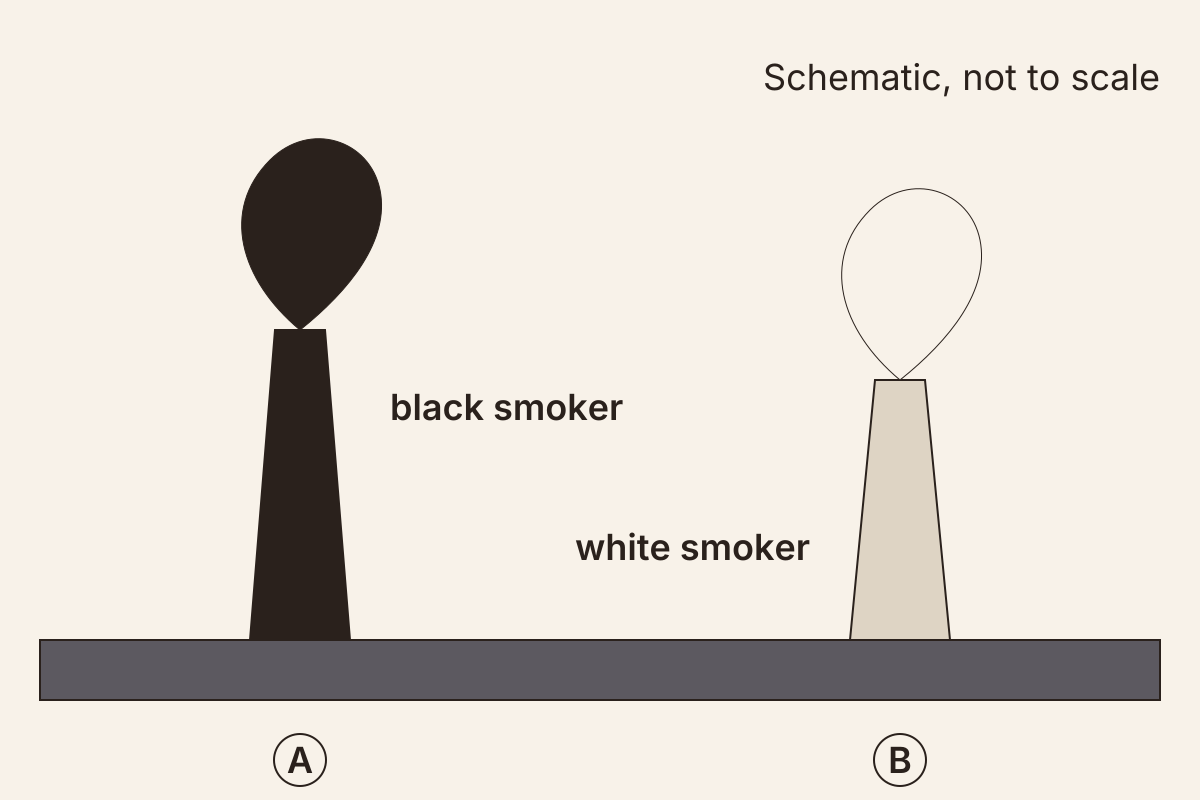
A black smoker and a white smoker compared: the color of each comes from the minerals its chimney is made of.
Evidence Chimney minerals from the NOAA Ocean Exploration fact sheet cited below; the drawing carries no measurements.
Key to the letters and numbers
- A Black smoker: a chimney of iron sulfide, which is black
- B White smoker: a chimney of barium, calcium and silicon deposits, which are white
"Black smokers and white smokers compared" by Strata & Seafloor, https://strataandseafloor.com/seafloor/hydrothermal-vents/, licensed under CC BY 4.0 (https://creativecommons.org/licenses/by/4.0/)
Data: NOAA Ocean Exploration, Hydrothermal Vents fact sheet (facts cited; text not reproduced), retrieved 2026-11-17
Black smokers entered the record after the Galápagos dive. Chen and colleagues write that once high-temperature black smokers were found on the East Pacific Rise, exploration shifted away from the Galápagos Rift, where vigorous venting was apparently lacking. High-temperature chimneys on the western Galápagos Rift were not confirmed until 2005 to 2006.
1977: what the Galápagos dive found
The 1977 dive confirmed the vents and then found something its scientists had not expected. NOAA writes that “to their amazement,” the scientists found the vents surrounded by large numbers of organisms that had never been seen before. Chen and colleagues cite a 1979 paper by Corliss and colleagues for that first view of the vent animals.
Chen and colleagues give more detail. They write of “a supposedly nutrient-deficient deep seabed two and a half kilometers below the surface,” with dense groups of giant clams and mussels and “worms living in meter-long white tubes with red plumes swaying in shimmering water.” Their figure of two and a half kilometers matches the NOAA depth of 2,500 meters.
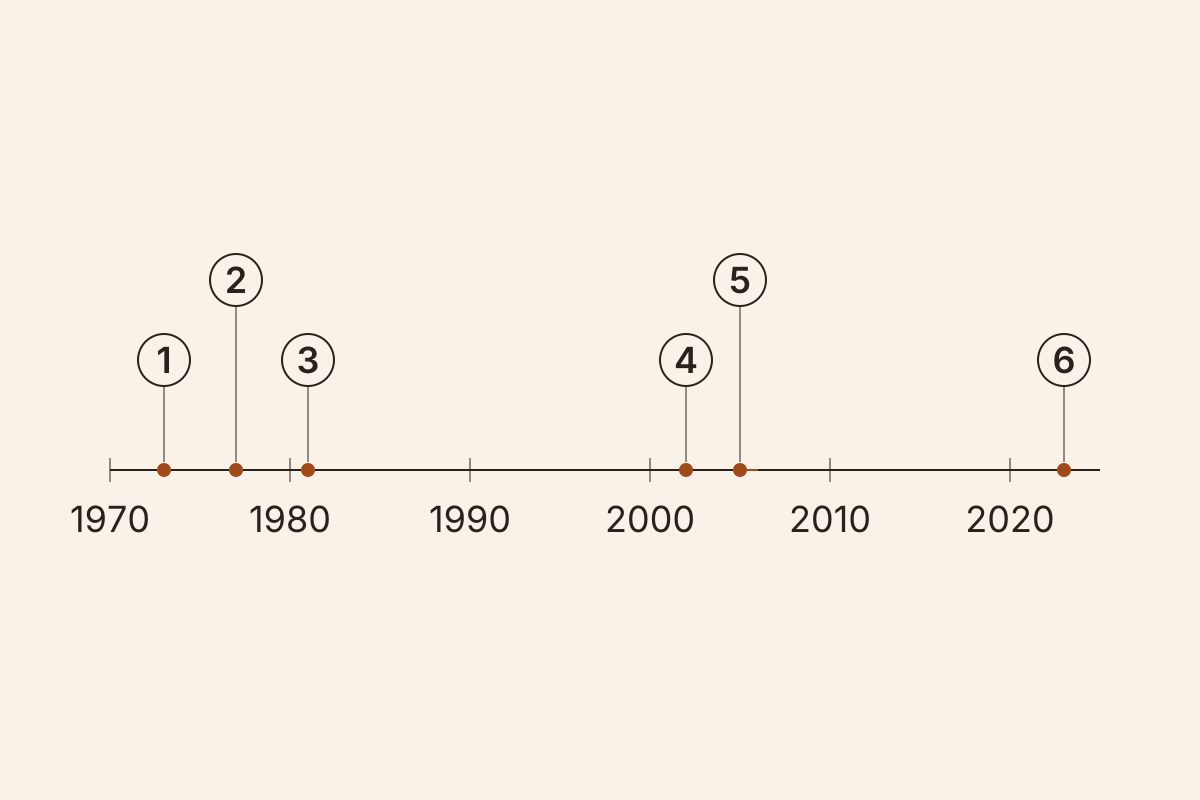
Six steps in the record of the Galápagos Rift vents, from the missing-heat paper to a return expedition in 2023.
Evidence Years from Chen, Jamieson and Tunnicliffe (2024) and the NOAA Ocean Exploration fact sheet cited below; events are placed by year on the axis.
Key to the letters and numbers
- 1 1973: a paper by Sclater and Klitgord on missing heat near ridge axes
- 2 1977: a paper by Weiss and others on warm plumes collected by a towed vehicle, and vents sighted at 2,500 m near the Galápagos Islands
- 3 1981: papers describe chemosymbiosis in vent animals
- 4 2002: an expedition finds the first vent field buried under fresh basaltic lava flows
- 5 2005 to 2006: towed-camera surveys confirm the first high-temperature chimneys on the western Galápagos Rift
- 6 2023: a return expedition to the Galápagos Rift vents; its 2024 paper lists 92 vent species
"Hydrothermal vents on the Galápagos Rift, 1973 to 2023" by Strata & Seafloor, https://strataandseafloor.com/seafloor/hydrothermal-vents/, licensed under CC BY 4.0 (https://creativecommons.org/licenses/by/4.0/)
Data: Chen, Jamieson and Tunnicliffe 2024, Marine Biodiversity 54:16, PMC10869388 (CC BY 4.0), retrieved 2026-11-17; NOAA Ocean Exploration, Hydrothermal Vents fact sheet (facts cited; text not reproduced), retrieved 2026-11-17
How long does a vent last?
A vent can disappear within a human lifetime. Chen and colleagues report that an expedition in 2002 found the first vent field, now called Rose Garden, buried under fresh basaltic lava flows, with its communities largely wiped out. The NOAA fact sheet explains why: vents and vent fields can be short-lived because of the tectonic and volcanic activity typical of plate boundaries.
Other vent areas last much longer. NOAA writes that some areas of hydrothermal activity are thought to have been active for hundreds, if not thousands, of years. The same page adds that new life can quickly settle a destroyed vent area again if a magma heat source remains.
Life without sunlight
Animals at vents live without sunlight because microbes there make food from chemicals. NOAA's chemosynthesis fact sheet defines chemosynthesis as “the process by which food is made by bacteria or other living things using chemicals as the energy source, typically in the absence of sunlight.” It also says chemosynthesis was first observed as the basis of a food web in 1977, during the expedition near the Galápagos Islands.
The chemistry starts with the vent water itself. NOAA notes that hydrogen sulfide, H2S, is abundant in the hot water erupting from vents. Microbes, including bacteria and archaea, harness energy released by reactions with chemicals like this one and use it to turn inorganic carbon into food, a step called carbon fixation. The fact sheet adds that no single chemical pathway defines chemosynthesis.
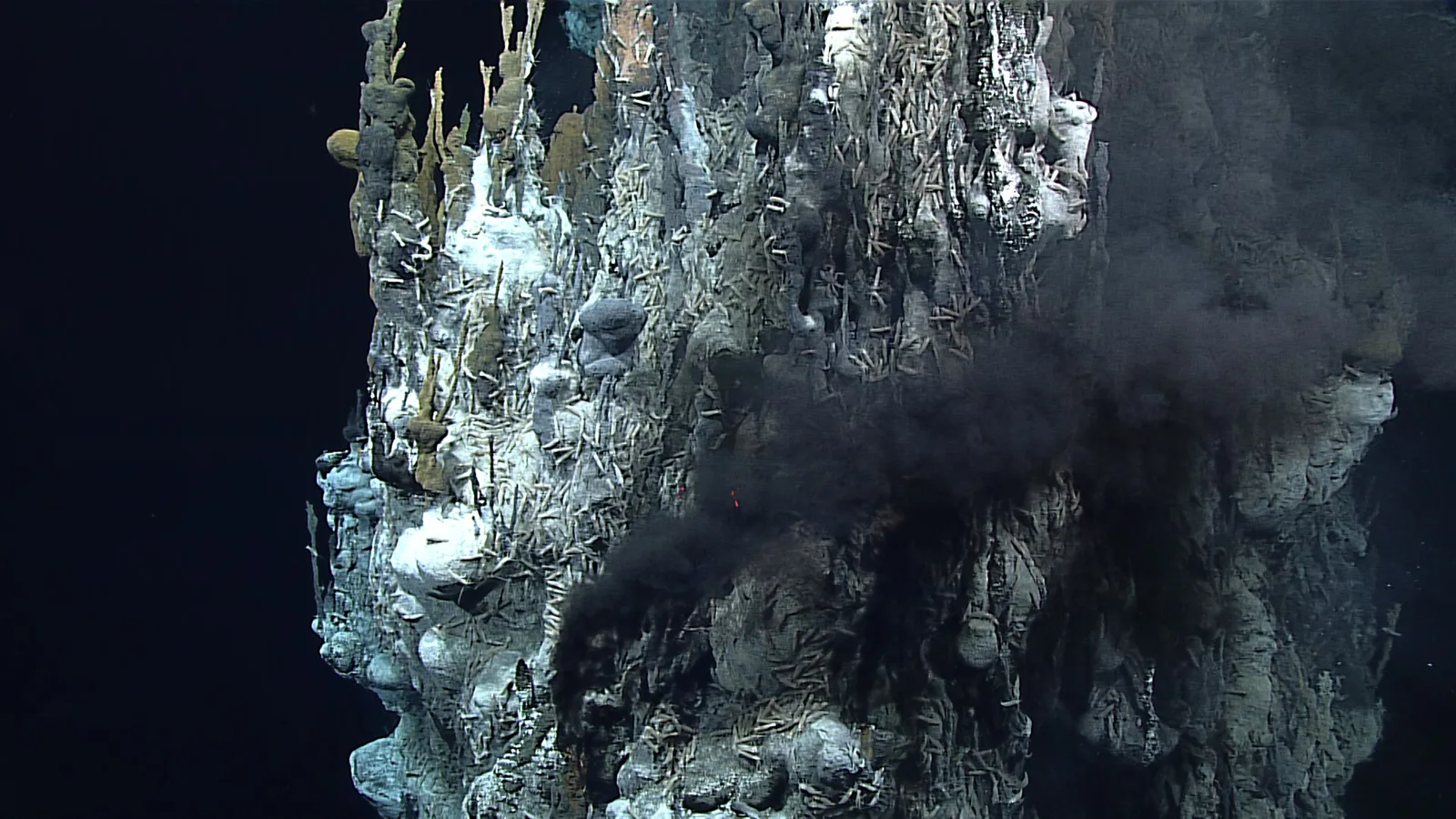
An active vent chimney seen during the 2016 Deepwater Exploration of the Marianas, shrouded in black smoke and covered with shrimp, crabs, snails and scaleworms, as NOAA describes it.
“Active Hydrothermal Vent, from the 2016 Deepwater Exploration of the Marianas”, NOAA Ocean Exploration, 2016 Deepwater Exploration of the Marianas; public domain.
Full credit
"Active Hydrothermal Vent, from the 2016 Deepwater Exploration of the Marianas" by NOAA Ocean Exploration, 2016 Deepwater Exploration of the Marianas — https://oceanexplorer.noaa.gov/multimedia/explorations-ex2405-ex2406-learning-at-sea-1605activevent/ — Public Domain (US: U.S. Government work (17 U.S.C. §105), image credited to NOAA Ocean Exploration, 2016 Deepwater Exploration of the Marianas, with no partner credit; NOAA Ocean Exploration states that website content resides in the public domain; EU: no statutory public-domain basis, agency public-domain statement)
These microbes are the base of the food web at vents, which NOAA says may include tubeworms, shrimp, clams, fish, crabs and octopods. The NOAA vent fact sheet says animals there are adapted to total darkness and to pressures hundreds of times that at sea level. According to the chemosynthesis fact sheet, some animals eat the microbes, and others, such as tubeworms and mussels, host them inside their bodies.
The vents also figure in a question about early life. The NOAA vent fact sheet says scientists hypothesize that life on Earth first arose at hydrothermal vents. That is a hypothesis under study, not a settled finding, and studying vent life gives researchers clues, in NOAA's words, about the origins of life.
Where are hydrothermal vents found?
The NOAA fact sheet places hydrothermal vents where magma rises under the seafloor at plate boundaries, and it names two settings. One is at divergent boundaries, also called seafloor spreading centers, where plates move apart; its examples are the Mid-Atlantic Ridge and areas in the Indian Ocean.
The other is at convergent boundaries, where plates collide and one often sinks beneath the other at a subduction zone. NOAA points to the “Ring of Fire” along the edges of the Pacific Ocean. In both settings, the fact sheet says, submarine volcanism produces hydrothermal venting.
Scale schematic, not to scale
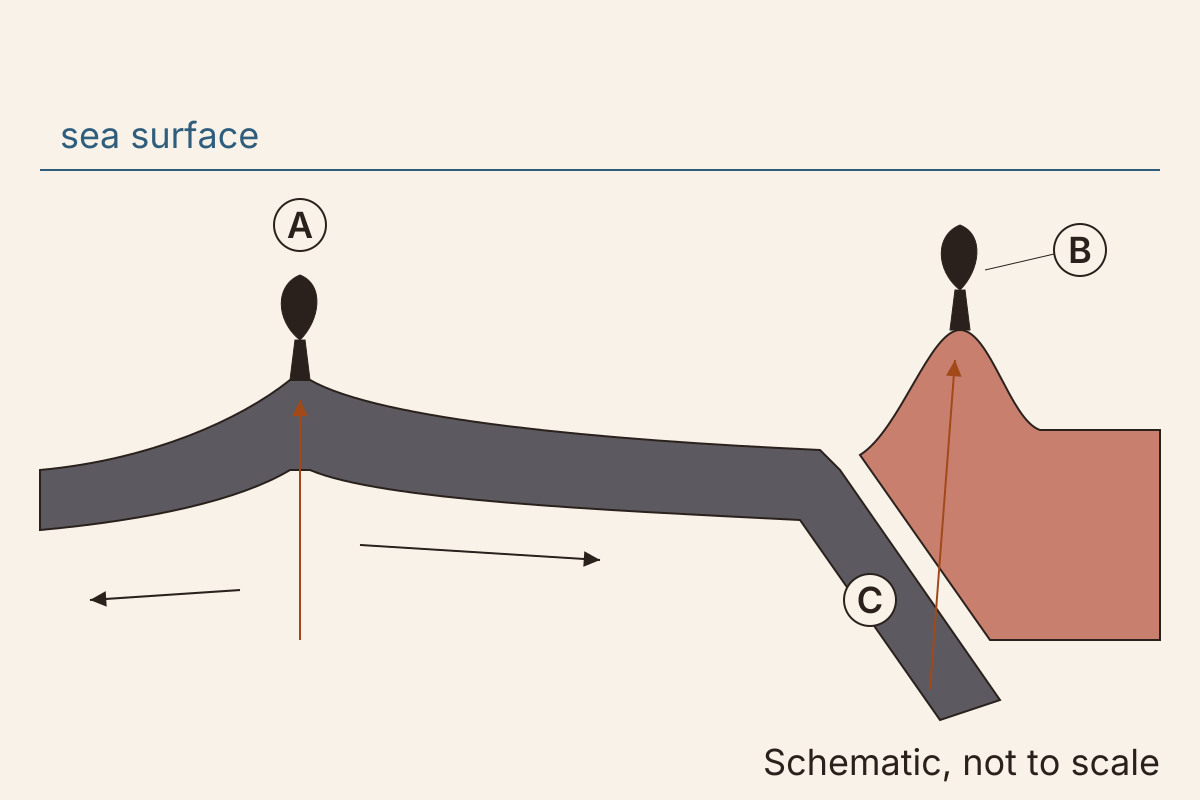
Vents form at spreading ridges, where plates move apart, and at undersea volcanoes above subduction zones, where one plate sinks under another.
Evidence Settings from the NOAA Ocean Exploration fact sheet cited below; no depths or distances are plotted.
Key to the letters and numbers
- A Vent at a spreading center (divergent boundary), such as the Mid-Atlantic Ridge
- B Vent at an undersea volcano above a subduction zone (convergent boundary), as along the Pacific “Ring of Fire”
- C Ocean plate sinking at the subduction zone
"Where hydrothermal vents form" by Strata & Seafloor, https://strataandseafloor.com/seafloor/hydrothermal-vents/, licensed under CC BY 4.0 (https://creativecommons.org/licenses/by/4.0/)
Data: NOAA Ocean Exploration, Hydrothermal Vents fact sheet (facts cited; text not reproduced), retrieved 2026-11-17
The plates move slowly. NOAA says convection in the hot mantle layer below them is thought to move tectonic plates several centimeters per year relative to each other. At the first Galápagos vent field, the rock found burying the vents in 2002 was fresh basaltic lava; lava that erupts under water is the subject of pillow lava. Far from the ridges, the seafloor rises to the shallow continental shelf, a continent's drowned edge.
The hot water also changes the rock it passes through, trading chemicals with it along the way. That exchange is one path in the rock cycle, where rock of one kind becomes another.
The spreading ridges where vents like the Galápagos ones sit are the subject of seafloor spreading. For minerals that settle out of water into open space on land, see how geodes form.
Sources
- NOAA Ocean Exploration, "Hydrothermal Vents", fact sheet, Deep Ocean Education Project (created in cooperation with the National Marine Sanctuary Foundation under federal award NA19OAR0110405). oceanexplorer.noaa.gov/wp-content/uploads/2022/10/hydrot…Read: full textText license: NOAA Ocean Exploration fact sheet (PDF): NOAA states that in general all content on its website resides in the public domain, with copyrighted media posted only on a limited basis; cited here for facts, text not reproduced (terms)
- Chen, C., Jamieson, J. W., and Tunnicliffe, V., 2024, Hydrothermal vent fauna of the Galápagos Rift: updated species list with new records: Marine Biodiversity, v. 54, article 16. pmc.ncbi.nlm.nih.gov/articles/PMC10869388/Read: full text (abstract and introduction used)Text license: CC BY 4.0 (terms)
- NOAA Ocean Exploration, "Chemosynthesis", fact sheet, Deep Ocean Education Project (created in cooperation with the National Marine Sanctuary Foundation under federal award NA19OAR0110405). oceanexplorer.noaa.gov/wp-content/uploads/2023/02/chemos…Read: full textText license: NOAA Ocean Exploration fact sheet (PDF): NOAA states that in general all content on its website resides in the public domain, with copyrighted media posted only on a limited basis; cited here for facts, text not reproduced (terms)
- NOAA Ocean Exploration, "Active Hydrothermal Vent", image page, 2016 Deepwater Exploration of the Marianas. oceanexplorer.noaa.gov/multimedia/explorations-ex2405-ex…Read: full text (caption and credit)Text license: NOAA Ocean Exploration multimedia page; image credit as given on the page: NOAA states that in general all content on its website resides in the public domain, with copyrighted media posted only on a limited basis; cited here for facts, text not reproduced (terms)
- Corliss, J. B., and others, 1979, Submarine thermal springs on the Galápagos Rift: Science, v. 203, p. 1073-1083. doi.org/10.1126/science.203.4385.1073Read: bibliography only
Cite this page
Strata & Seafloor. “Hydrothermal Vents: Found Where Geologists Expected Heat.” First published November 18, 2026. https://strataandseafloor.com/seafloor/hydrothermal-vents/. Accessed on the day you read it.
How ages and sources are checkedAll correctionsReport an error on this page (contact@strataandseafloor.com)
Also in Seafloor
SF Reading the evidence
Seafloor Spreading: Magnetic Stripes Mirror Across the Ridge
Filed
Picture credit
"Bathymetric chart of the North Atlantic, by Matthew Fontaine Maury" by Matthew Fontaine Maury — https://commons.wikimedia.org/wiki/File:Maury_1854_Bathymetric_Chart_pl23_map00002.jpg — Public Domain (US: published 1854, before 1931, so out of copyright by age; also a U.S. Government work (17 U.S.C. §105) by U.S. Navy Lieutenant Matthew Fontaine Maury in his official duties, the plate engraved and printed by J. M. Butler, Philadelphia (contractor; covered by the publication-date basis); EU: author d. 1873, published 1854 (engraver's death year not traced; for an 1854 plate, death before 1956 is practically certain, as accepted for the 1832 Lyell plate); upstream not traced)
SF Field entry
Continental Shelf: Much of It Was Dry Land in the Ice Age
Filed
Picture credit
"Continental shelf off the Golden Gate, San Francisco, California true-color composite, Sentinel-2 L2A scene S2B_T10SEG_20250324T190338_L2A via Earth Search (Element 84)" by Strata & Seafloor — https://earth-search.aws.element84.com/v1/collections/sentinel-2-c1-l2a/items/S2B_T10SEG_20250324T190338_L2A — Copernicus Sentinel data legal notice (https://sentinels.copernicus.eu/documents/247904/690755/Sentinel_Data_Legal_Notice); modified: cropped, resampled, color-stretched; rights notice: Contains modified Copernicus Sentinel data 2025
SF Field entry
Pillow Lava: A Glassy Rind Forms Where Lava Meets Water
Filed
Picture credit
"Expl6426 - broken pillow lava, NOAA Okeanos Explorer Program, Galapagos Rift Expedition 2011" by NOAA Okeanos Explorer Program, Galapagos Rift Expedition 2011 — https://commons.wikimedia.org/wiki/File:Expl6426_-_broken_pillow_lava.jpg — Public Domain (US: U.S. Government work (17 U.S.C. §105), NOAA Okeanos Explorer Program photo taken as part of an employee's official duties per the file page (PD-USGov-NOAA); EU: no statutory public-domain basis, agency public-domain marking; upstream not traced)